

How Social Media Comparison Can Make Us Feel Behind in Life
- October 02, 2026
- by
- Debkanya Benerjee
There was a time when I genuinely believed that life could be planned.
We study, build a career, earn money, create a family, buy a home, travel when we can, save for the future and slowly arrive at the life we imagined for ourselves. At least, that was the picture I carried in my mind for a long time.
Perhaps many of us do.
We grow up with ideas about where we should be by a certain age. We make plans, set goals and quietly create a picture of the person we think we will become.
And then life happens.
Not according to the plan, not according to the timeline and not always according to what we thought we wanted.
Some things happen earlier than expected. Some arrive years later. Some never happen at all. And, surprisingly, some of the things we never planned become the parts of our lives we eventually value the most.
When a Digital Strategy Made Me Think About Life
I was thinking about this recently while working on a digital strategy. I was looking at audience behaviour, social-media trends, content consumption and the enormous amount of time people spend in digital spaces. Somewhere between the numbers and the strategy, my thoughts moved away from marketing and towards life.
It also reminded me of a conversation I had quite a few years ago with an eminent person who, to me, has always been a keen observer of life and human behaviour.
During one of our conversations, I casually asked him, “Do you have a Facebook profile?”
He smiled and simply said, “No.”
I was a little surprised. At that time, Facebook was already such a familiar part of everyday life that I couldn’t quite understand why someone like him would deliberately stay away from it.
So I asked him why.
He smiled again and said something that I didn’t fully understand then. He told me that some platforms could feel rather unreal when it came to the profiles people created for themselves. He preferred Instagram, but he kept himself “much, much away from Facebook.”
I remember that conversation, but I don’t think I truly understood his answer that evening.
Today, while looking at social-media behaviour, digital identities and the way we present ourselves online, I suddenly remembered his words.
And, honestly, I now understand why he smiled when I asked him about his Facebook profile.
Perhaps he had already observed something that I was only beginning to understand.
The person we present to the digital world is not always the person we are living as in the real world.
Back then, I heard his words as an opinion.
Today, I hear them as an observation.
And that observation took me somewhere beyond digital strategy and into a much more personal question:
Are we still living the lives we genuinely want, or are we slowly learning to perform the lives we think we are supposed to have?
The Numbers Behind the Digital World
That question made me look at social media differently.
We are living through an extraordinary period of human connectivity. According to DataReportal’s Digital 2026: India report, India had around 500 million social media user identities in October 2025, equivalent to 34.1% of the country’s total population. India also had approximately 1.03 billion internet users at the end of 2025. DataReportal estimates that 48.7% of India’s internet users were using social media at that time.
Globally, the numbers are even more striking. Around 5.79 billion social media user identities were recorded at the start of April 2026, equivalent to approximately 69.9% of the world’s population.
There is an important detail here that I found particularly interesting while researching this. These figures refer to user identities, not necessarily unique human beings. Multiple accounts, duplicate identities and differences in platform reporting mean that these numbers should not simply be interpreted as a headcount of individual people.
That distinction may sound like a technical footnote.
To me, it became something much more meaningful.
Numbers can tell us how connected the world is. They cannot tell us how connected we are to ourselves.
And perhaps that is the conversation we need to have.
I Don’t Think Social Media Is the Enemy
I use social media. I learn from it. I discover writers, businesses, ideas, recipes, places, photographs and stories that I might never have encountered otherwise.
As someone who works with content and digital strategy, I understand why these platforms have become so powerful.
Social media can give a small business a voice. It can help a new creator find an audience. It can connect people who would otherwise never meet. It can educate, entertain and sometimes even give someone the courage to begin something they had been postponing for years.
So I don’t believe the answer is to simply declare that social media is bad.
That would be too convenient.
The question, for me, is a little more uncomfortable:
What are we allowing social media to do to the way we see our own lives?
Because there is a difference between using a digital platform and allowing that platform to quietly become the measuring scale for our happiness.
When Someone Else’s Life Becomes Our Measuring Scale
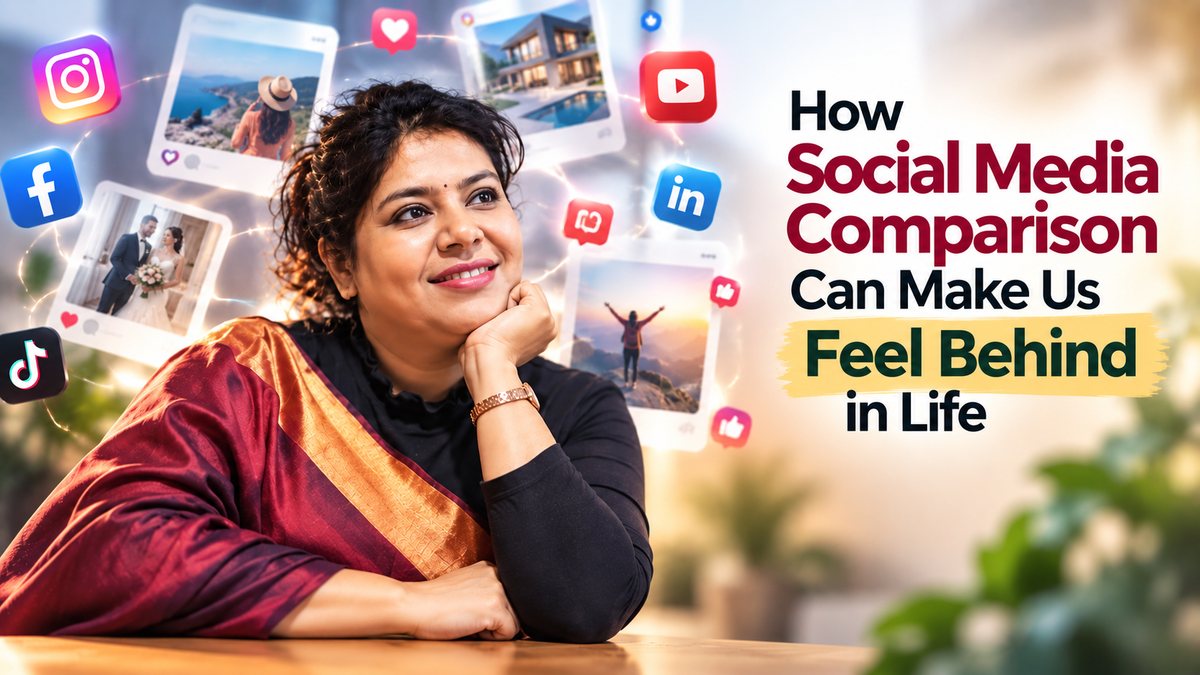
Open Instagram or YouTube on any ordinary day and we are immediately surrounded by other people’s moments.
Someone is travelling.
Someone is getting married.
Someone has launched a business.
Someone has bought a house.
Someone has lost weight.
Someone has received a promotion.
Someone is celebrating a child’s achievement.
Someone is working from a beautiful café.
Someone is publishing a book.
Someone is showing us their morning routine.
Someone is telling us how they transformed their life in thirty days.
And then there is us.
Perhaps sitting at home with unfinished work, responsibilities waiting in the next room, bills to be paid, a career that didn’t unfold exactly as planned and a few dreams that have been postponed because life needed our attention elsewhere.
Nothing may actually be wrong with our lives.
And yet, after scrolling for twenty minutes, we can somehow feel as though we are falling behind.
That is the strange psychology of comparison.
We see someone’s finished photograph and compare it with our unfinished life.
We see their achievement but not the years behind it.
We see the holiday but not the financial planning.
We see the successful business but not the failed attempts.
We see the confident person but not the uncertainty that may have existed before the camera was switched on.
We see the announcement, not the journey.
And that is an unfair comparison.
The Life I Planned Wasn’t the Life I Lived
I have had plans too.
I have imagined how certain chapters of my life would unfold. I have thought about career, achievement, relationships, motherhood, money, creativity and the kind of person I wanted to become.
But life has its own editing room.
It removes scenes we thought were essential. It adds characters we never expected. It changes the setting. It introduces plot twists we certainly didn’t ask for.
And sometimes, years later, we look back and realise that the chapter we once wanted to skip was the one that taught us something we desperately needed to know.
The ancient Stoic philosopher Marcus Aurelius repeatedly reflected on the importance of directing our attention towards what is within us rather than becoming consumed by external approval.
Reading ancient philosophy in the middle of today’s digital world can feel surprisingly relevant.
Because social media has created an enormous marketplace of appearances.
We don’t always ask ourselves, “Am I happy?”
Sometimes we ask, “Does my life look happy?”
Those are two very different questions.
When Living Becomes Something We Document
A beautiful dinner becomes a photograph. A holiday becomes a carousel. A birthday becomes a reel. A professional achievement becomes a post. A new purchase becomes an unboxing video.
Even ordinary moments can begin to feel incomplete until they have been photographed, edited and shared.
There is absolutely nothing wrong with sharing a beautiful moment.
The question is what happens when the documentation becomes more important than the moment itself.
I have caught myself thinking about this.
Imagine sitting beside the sea. The wind is moving through your hair. The sound of the waves is doing something to your mind that you cannot quite explain. The sky is changing colour.
But instead of being there, you are searching for the right angle.
You take one photograph.
Then another.
Then another.
You check them.
You edit one.
You write a caption.
You think about when to post it.
And suddenly the sunset is over.
You have successfully documented the moment.
But did you experience it?
That question has stayed with me.
Perhaps one of the quiet costs of the digital age is not that we have stopped living.
It is that sometimes we have become better at documenting life than experiencing it.
What the Ancient Philosophers Still Have to Teach Us
This is also where an old idea from Epictetus feels surprisingly contemporary.
The Stoic philosopher wrote about distinguishing between what is within our control and what is not. Our choices, actions and responses belong largely to us. Other people’s opinions and reactions do not.
Think about that for a moment in the age of likes, comments, shares and algorithms.
We can decide what we create.
We can decide what we consume.
We can decide whom we follow.
We can decide how much of our attention we give to our phones.
We can decide whether we continue learning.
We can decide whether we start again.
But we cannot completely decide who will like our work, whether a post will reach thousands of people, whether an algorithm will favour it or what someone else will think about us.
Yet how often do we allow those things to determine how we feel about ourselves?
That is something I am still learning.
The Invisible Timeline We Have Created for Ourselves
The digital world has also made something else very visible to me: how obsessed we have become with timelines.
There seems to be an invisible schedule for life.
By twenty-five, you should know what you are doing.
By thirty, you should be established.
By thirty-five, perhaps you should own a home.
By forty, you should have achieved something significant.
By fifty, you should have everything figured out.
And somewhere between all these expectations, we are also supposed to travel, stay fit, maintain beautiful relationships, raise successful children, build wealth, develop multiple income streams and somehow remain mentally peaceful.
But who decided that everyone has to sit for the same examination on the same day?
Life doesn’t work that way.
Some people discover their calling at twenty.
Some discover it at forty.
Some build successful businesses quickly.
Others spend years acquiring experience before finally creating something that feels truly theirs.
Some people know exactly what they want.
Others need to try several different lives before discovering which one fits.
There is no universal calendar for becoming yourself.
Your timeline is yours.
Sometimes the Plan Needs to Change
And this is where I think we need to be kinder to ourselves.
A delayed dream is not necessarily a dead dream.
A career change is not necessarily a failed career.
Starting again is not necessarily going backwards.
Sometimes the plan changes because we have changed.
The person who made a five-year plan five years ago may not be the person sitting here today.
Our priorities change.
Our responsibilities change.
Our definition of success changes.
Even our dreams change.
And sometimes the bravest thing we can say is:
“I don’t want this anymore.”
Not because we failed.
Because we finally understood ourselves better.
That is a very different thing.
What an Algorithm Can Never Understand
My work in digital content has also taught me something I find useful far beyond marketing.
An algorithm can measure signals.
It can measure reach, views, clicks, watch time, engagement and shares.
But it cannot measure the complete meaning of a human life.
It doesn’t know that a post which received very little engagement took someone three days to write.
It doesn’t know that the small business owner who made one sale today has been trying for six months.
It doesn’t know that the person who looks confident online once struggled to believe in themselves.
It doesn’t know what it meant for someone to sit beside an ageing parent for an hour without touching their phone.
It doesn’t know what a child’s laughter did to someone’s heart after a difficult day.
It doesn’t know how much courage it took for someone to begin again.
The digital world can measure attention.
It cannot measure meaning.
And perhaps we need to stop confusing the two.
The Questions I Have Started Asking Myself
This is why I have started asking myself a few simple questions.
If nobody could see this, would I still want it?
If nobody applauded this achievement, would it still matter to me?
If this photograph received no likes, would I still want the memory?
If nobody knew about this dream, would I still pursue it?
And perhaps the most important question:
Am I building a life, or am I building evidence that I have a good life?
I don’t always have perfect answers.
I don’t think anyone does.
But asking the question changes something.
It makes us pause.
And sometimes a pause is exactly what we need in a world designed to keep us scrolling.
What If We Stopped Comparing and Started Observing?
The next time someone else’s success appears on your screen, perhaps you don’t have to immediately think, Why don’t I have that?
Try asking:
What is this showing me about what I genuinely want?
That tiny shift can turn comparison into self-reflection.
Someone else’s success doesn’t have to become evidence of our failure.
It can simply show us a possibility.
Someone else’s journey can inspire us without making our journey feel inadequate.
Someone else’s life can remain theirs.
And ours can remain ours.
Being Visible Is Not the Same as Being Fulfilled
I think this is where the digital world has something important to teach us.
We need digital literacy, but we also need emotional literacy.
We need content creation, but we also need self-creation.
We need online visibility, but we also need inner clarity.
We need analytics, but we also need awareness.
We need professional networks, but we also need people we can call when life becomes difficult.
We need photographs, but we also need memories that were never photographed.
We need goals, but we also need the ability to change them when life changes us.
Most importantly, perhaps, we need to understand the difference between being visible and being fulfilled.
These are not the same thing.
A person can have thousands of followers and still feel lonely.
A person can have a small audience and be deeply fulfilled by their work.
A post can go viral and mean very little.
A quiet conversation can receive no likes at all and remain one of the most important moments of someone’s life.
The algorithm will never know the difference.
We do.
Perhaps We Are Not Behind After All
So, if your life doesn’t look the way you imagined it would, take a breath.
You are not necessarily behind.
You are not necessarily lost.
You may simply be living a chapter that wasn’t included in the original plan.
And perhaps one day, when you look back, you will realise that the chapter you once called a detour was actually the chapter that taught you how to live.
The life I planned for myself was a picture.
The life I actually live is a collection of moments I could never have predicted.
Some beautiful.
Some difficult.
Some ordinary.
Some completely unexpected.
But all of them are mine.
And perhaps that is what growing older has taught me most clearly: I don’t need every chapter to look impressive.
I need it to be honest.
I don’t need to create a life that looks extraordinary to everyone watching from outside.
I want to create a life that feels meaningful when there is nobody watching.
Because when the phone is finally put down, when the notifications stop, when the photographs are no longer being taken and the audience disappears, we are left with something far more important than our digital identity.
We are left with ourselves.
And that is the one relationship we cannot outsource.
Maybe the Life We Live Is the Story
So perhaps the question isn’t whether we are living the life we planned.
Perhaps the better question is:
Are we paying enough attention to the life we are actually living?
Because maybe the plan was never the destination.
Maybe it was only the beginning.
Life took the rest of the journey from there.
And perhaps, after all the planning, comparing, postponing and worrying about whether we were doing enough, the real work is much simpler.
To notice.
To learn.
To grow.
To change when necessary.
To love the people who are here.
To pursue what still matters.
To let go of what no longer does.
And to stop measuring our unfinished lives against someone else’s carefully edited frame.
I planned my life.
Then life happened.
And today, I think I am beginning to understand that perhaps this was not the failure of the plan.
Perhaps this was the plan all along.

You may also Like

How to Turn Everyday Experiences Into Creative Ideas

Why Creative People Get Stuck — And How to Start Creating Again