

On Writing by Stephen King: What Writers Can Actually Learn from It
- September 14, 2026
- by
- Biswajit Mohanty
There are plenty of books that tell you how to write.
Some teach grammar.
Some teach storytelling.
Some give you formulas for characters, plots, headlines, or dialogue.
And then there is On Writing by Stephen King.
It doesn’t feel quite like a writing manual.
It doesn’t feel like a conventional autobiography either.
It sits somewhere between the two.
King tells you about becoming a writer while explaining what he believes makes writing work.
That combination is probably what makes the book so readable.
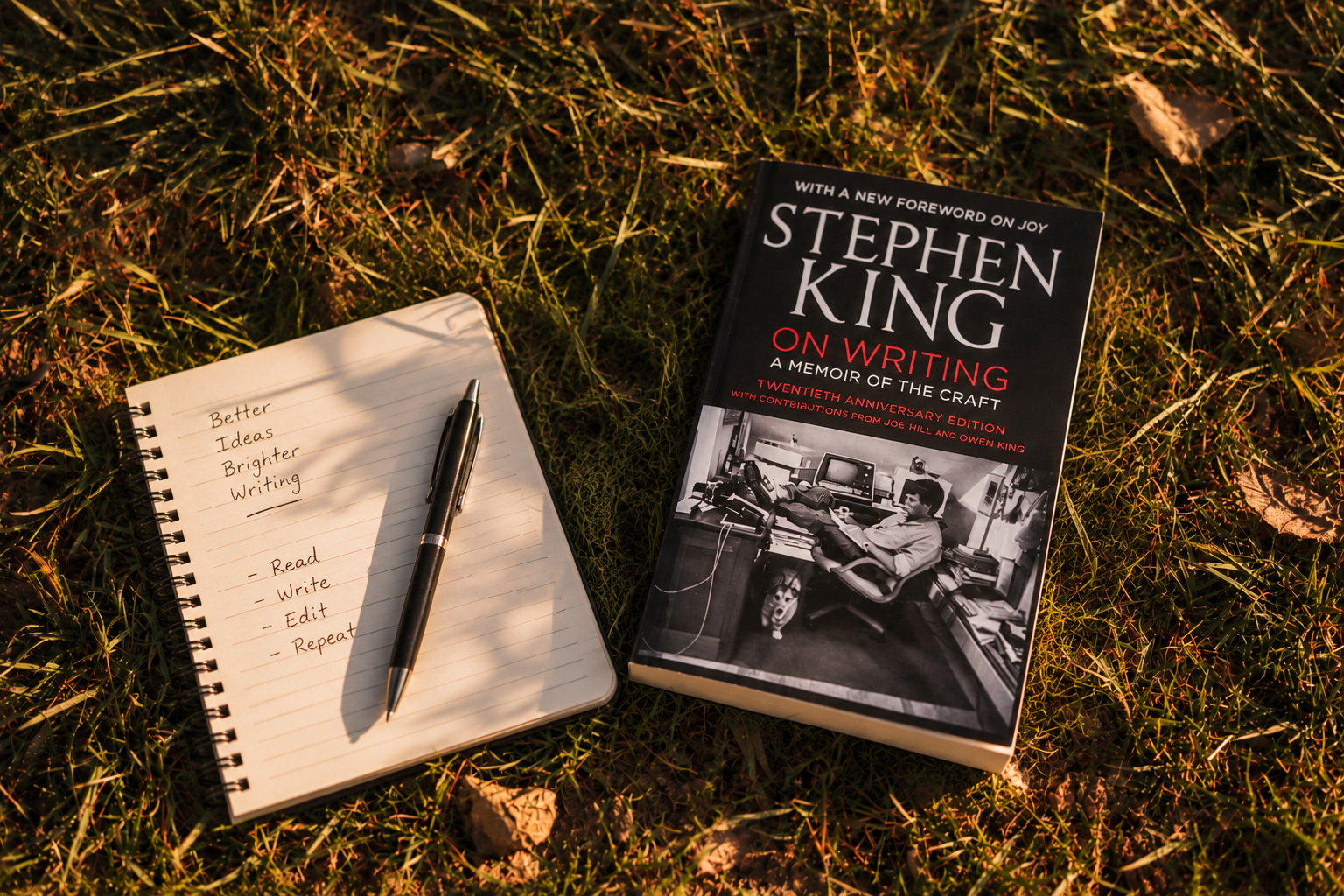
Published in 2000 by Scribner, On Writing: A Memoir of the Craft combines King’s life story with his ideas about writing. The book covers his childhood, early attempts at writing, struggles before Carrie, his career, the mechanics of writing, and his recovery after a nearly fatal accident in 1999. (Stephen King)
But I don’t think the biggest value of this book is learning how Stephen King writes.
It’s understanding how seriously a professional writer treats the craft.
And that lesson applies far beyond fiction.
The Book Is Not Really About Stephen King’s Success
This is what I find interesting about On Writing.
You might expect a famous writer to spend most of the book explaining how he became successful.
He doesn’t.
Yes, he talks about his childhood.
He talks about writing when he was young.
He talks about rejection.
He talks about his early jobs.
He talks about the years before Carrie changed his career.
But the book doesn’t present success as some magical moment.
Instead, you see years of writing, reading, submitting, failing, learning, and continuing.
That part matters.
Especially if you’re a writer who hasn’t yet reached the stage where people take your work seriously.
The Part That Hit Me as a Writer
I’ve been writing professionally for years.
And one thing you learn after spending enough time with writing is that the romantic idea of being a writer doesn’t survive for very long.
In the beginning, writing feels exciting.
You have ideas.
You want to publish them.
You imagine people reading your work.
Then writing becomes work.
A client wants another article.
A deadline moves closer.
Someone asks for another revision.
You stare at a blank document.
You write something.
You don’t like it.
You rewrite it.
Then you realize that writing professionally involves much more than having a love for words.
You need discipline.
You need patience.
You need to read.
You need to observe.
And you need to keep writing even when you don’t particularly feel like writing.
That is one reason On Writing feels relevant.
King doesn’t present writing as some mysterious gift reserved for a chosen few.
He treats it as a craft that needs to be practiced.
That distinction is important.
King Doesn’t Separate Reading From Writing
One of the book’s strongest ideas is the relationship between reading and writing.
King strongly advocates reading.
A lot of it.
This sounds obvious.
But many aspiring writers don’t actually read enough.
They want to write books.
They want to start blogs.
They want to become content writers.
But they don’t spend much time reading the kind of writing they want to produce.
That’s a problem.
You learn language partly by absorbing how other people use it.
You begin noticing sentence rhythm.
You notice how writers introduce ideas.
You notice when a paragraph feels too long.
You notice how dialogue works.
You notice when a story becomes boring.
Reading gives you examples.
Writing gives you practice.
You need both.
This is especially relevant today.
AI can generate a paragraph in seconds.
But generating words isn’t the same as developing judgment.
A writer needs to recognize when something sounds natural, awkward, unnecessary, exaggerated, repetitive, or simply boring.
Reading helps develop that judgment.
Writing Is Not About Showing How Much You Know
Another lesson I took from the book is the importance of simplicity.
Writers sometimes want to sound intelligent.
I’ve seen this many times.
A simple idea gets wrapped in complicated language.
The writer replaces an ordinary word with a sophisticated one.
The sentence becomes longer.
The meaning becomes harder to understand.
And somehow the writer thinks the article has become better.
It hasn’t.
Good writing doesn’t need to advertise the intelligence of the writer.
It needs to communicate the idea clearly.
This is particularly important in content writing.
Your reader isn’t reading your article to admire your vocabulary.
They’re reading because they want something.
An answer.
An explanation.
A solution.
An idea.
Give them that.
The Toolbox Idea Is More Useful Than It First Appears
One of the memorable sections of On Writing is the discussion of the writer’s “toolbox.”
King uses the idea of a toolbox to explain the fundamentals writers need.
Vocabulary and grammar matter.
But knowing the tools isn’t enough.
You also need to know when to use them.
That’s a useful way to think about writing.
A writer shouldn’t constantly think:
“Which impressive word can I use here?”
The better question is:
“What’s the clearest way to say this?”
Sometimes that’s a sophisticated sentence.
Sometimes it’s five simple words.
Good writers know the difference.
Write, Then Revise
This sounds simple.
It isn’t.
Many writers become obsessed with getting the first draft right.
They stop every few sentences.
They change words.
They rewrite paragraphs.
They question the introduction.
Then they go back to the first paragraph again.
I’ve done this too.
Sometimes you have to remind yourself:
The first draft doesn’t need to be beautiful. It needs to exist.
Once the words are on the page, you have something to work with.
That’s where editing becomes valuable.
You can remove unnecessary sentences.
You can fix awkward transitions.
You can simplify complicated explanations.
You can improve the introduction.
You can move paragraphs around.
You can find repetition.
The blank page gives you nothing to edit.
A bad first draft gives you something.
That alone is a useful lesson.
Don’t Fall in Love With Every Sentence
This is one of the hardest things for writers.
You write a sentence that sounds beautiful.
You like it.
So you keep it.
Even when it doesn’t help the article.
That’s dangerous.
A sentence can be beautifully written and still be unnecessary.
The same applies to paragraphs.
And sometimes entire sections.
The reader doesn’t care how much time you spent writing them.
They care whether they add value.
Good editing requires some emotional distance from your own words.
That’s not always easy.
But it’s necessary.
King’s Advice Isn’t a Universal Law
This is where I think readers should approach the book intelligently.
On Writing is based heavily on King’s experience.
He’s an extraordinarily successful novelist.
His advice deserves attention.
But that doesn’t mean every rule works for every writer.
King’s approach to fiction is particularly relevant to fiction writers.
A content writer, technical writer, journalist, copywriter, or academic writer works under different constraints.
A novelist can approach a story differently from someone writing a medical explainer.
A blogger has different goals from a screenwriter.
A technical writer has different responsibilities from a novelist.
So I wouldn’t read On Writing and try to copy Stephen King’s writing process.
I’d ask a better question:
What principle can I adapt to my own work?
That’s a much healthier way to learn from another writer.
The Book’s Most Powerful Lesson May Not Be About Writing
The final part of the book changes its emotional weight.
In 1999, King was struck by a vehicle while walking near his home in Maine. The accident nearly killed him and interrupted the writing of the book. His recovery became part of the story.
This isn’t just an interesting piece of biography.
It changes how you understand the book.
Writing wasn’t simply an intellectual exercise for King.
During recovery, writing became connected with returning to ordinary life.
The book ends up becoming partly about the relationship between writing and living.
That gives the title more meaning.
On Writing isn’t simply about how to construct sentences.
It’s also about what writing means to someone who has spent decades doing it.
What Content Writers Can Learn From This Book
You might wonder whether a book written by a novelist is useful for someone writing websites, blogs, product pages, or business content.
I think it is.
Not because you’ll learn SEO from it.
You won’t.
Not because it will teach you how to write a conversion-focused landing page.
It won’t.
Its value is more fundamental.
Read more than you write
Good writing requires exposure to good writing.
Write regularly
You don’t become better by thinking about writing.
You improve by doing it.
Keep your language clear
Don’t make sentences complicated just to sound professional.
Learn the fundamentals
Grammar, vocabulary, structure, and sentence construction still matter.
Edit without ego
Your favorite sentence may still need to disappear.
Develop your own judgment
Don’t blindly copy another writer’s process.
Take writing seriously
Treat writing as a craft rather than something you can master after reading a few tips.
These lessons apply whether you’re writing a novel or a 1,000-word blog post.
What I Didn’t Like About the Book
A good review shouldn’t only praise a book.
On Writing has limitations.
Some of King’s advice is strongly shaped by his own preferences.
That’s inevitable.
He’s explaining writing from the perspective of a highly successful novelist.
Some readers may also find parts of the memoir more interesting than others.
If you’re looking exclusively for a technical writing textbook, this isn’t it.
And if you’re looking for a systematic course covering every aspect of writing, you’ll find gaps.
That’s okay.
The book doesn’t need to be everything.
Its strength is the combination of experience, craft, honesty, and encouragement.
Kirkus similarly describes it as both a memoir of King’s life and a practical discussion of writing, highlighting his advice on story construction, revision, reading, writing, and career.
Who Should Read On Writing?
I’d recommend it to:
Aspiring writers
You’ll get both encouragement and practical advice.
Content writers
The lessons about clarity, reading, discipline, and editing translate well.
Bloggers
It can help you think beyond keywords and publishing schedules.
Fiction writers
This is obviously where much of the book’s craft advice is most directly relevant.
People who want to write but keep postponing it
You may find the book useful simply because it makes writing feel like something you should actually sit down and do.
But if you already have a very rigid writing system that works for you, don’t expect the book to replace it.
Take what helps.
Leave what doesn’t.
Is On Writing Still Worth Reading?
Yes.
More than two decades after its original publication, I think it remains worth reading because its strongest lessons aren’t tied to a particular technology or publishing platform.
The internet has changed.
SEO has changed.
Social media has changed.
AI has changed the way people create content.
But writers still face many of the same problems.
They procrastinate.
They overthink.
They struggle with first drafts.
They use unnecessary words.
They avoid editing.
They compare themselves with better writers.
And sometimes they simply don’t write enough.
Technology can change the tools.
It doesn’t remove the need for craft.
That’s where On Writing still feels relevant.
My Verdict
If you’re looking for a book that teaches you everything about writing, this isn’t it.
No single book can.
But if you want to spend time inside the mind and working life of a highly successful writer while picking up practical lessons about the craft, On Writing is difficult to ignore.
What I like most about it is that King doesn’t make writing feel magical.
He makes it feel like work.
Not miserable work.
Not mechanical work.
But work that becomes meaningful when you keep doing it.
And perhaps that’s the most useful lesson for any writer.
You don’t need to wait until you feel like a writer.
You don’t need someone to give you permission.
You don’t need perfect conditions.
You need to read.
You need to write.
You need to revise.
And then you need to do it again.
That’s probably the real lesson of On Writing.
Writing isn’t something you become good at by wanting to be a writer.
You become a better writer by doing the work.
Rating: 4.5/5
Best for: Aspiring writers, content writers, bloggers, and anyone serious about improving their craft.
My takeaway: Don’t try to write like Stephen King. Learn to take your own writing seriously.
