


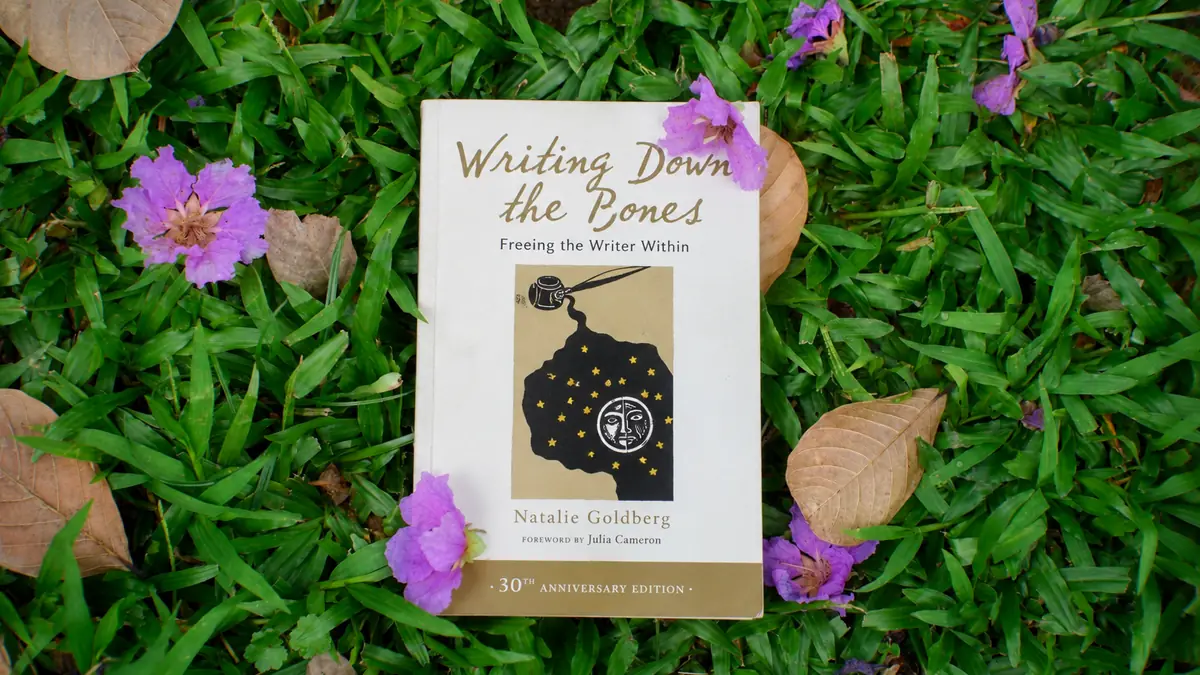
Writing Down the Bones by Natalie Goldberg: Finding Freedom Through Writing
- October 09, 2026
- by
- Biswajit Mohanty
Some writers wait for the right idea, the perfect opening sentence, or a quiet moment when their thoughts finally fall into place. Natalie Goldberg’s Writing Down the Bones: Freeing the Writer Within offers a different approach: stop waiting for writing to feel perfect and begin putting words on the page.
First published in 1986, this book has become a familiar title in conversations about creative writing and writing practice. Rather than presenting a rigid formula for producing better work, Goldberg encourages writers to develop a regular habit, pay closer attention to the world around them, and become less afraid of their own words.
But what makes Writing Down the Bones worth reading? And does its advice still help writers who struggle with distraction, perfectionism, or the pressure to produce something worthwhile?
What Is Writing Down the Bones About?
Writing Down the Bones is a book about developing a writing practice. Its central concern is not simply how to construct a polished essay, story, or novel, but how to become someone who writes regularly.
Goldberg draws connections between writing, attention, discipline, and Zen practice. She encourages writers to work with their first thoughts instead of immediately judging them, to observe ordinary experiences closely, and to treat writing as an activity that improves through repetition.
The book is organised into short chapters, each exploring a particular aspect of the writing process. Topics include overcoming the inner editor, being specific, listening, trusting yourself, and understanding the difference between writing practice and revision.
This structure makes the book approachable. Readers can spend time with an individual idea rather than having to absorb a lengthy, step-by-step writing system.
1. Write Before You Start Judging Your Words
One of Goldberg’s best-known ideas is the practice of writing from your first thoughts. Instead of stopping after every sentence to decide whether it sounds intelligent, original, or grammatically perfect, you keep writing and allow your thoughts to develop on the page.
This approach challenges a common problem: trying to write and edit at the same time.
When you judge every sentence as soon as it appears, you interrupt your own thinking. A promising idea can disappear beneath concerns about word choice, structure, or whether the subject is interesting enough.
Goldberg’s approach gives the first draft a different purpose. It is a place to explore rather than a finished product that must immediately impress someone.
For example, suppose you want to write about a childhood memory. You might begin by describing a room, a smell, a conversation, or a small detail you have not thought about in years. You do not need to know the final point of the piece before you begin.
The important thing is to keep going long enough to discover what the memory contains.
The practical lesson: Separate the act of generating ideas from the act of improving them. A rough paragraph can be revised. An idea you never allow yourself to explore cannot.
2. Learn to Quiet Your Inner Editor
Every writer needs editing skills. The problem begins when the editor appears too early.
You may recognise the pattern: write a sentence, delete it, try another, change the opening, and eventually abandon the document. Hours pass, but the piece barely grows.
Goldberg explores this tendency through the idea of the inner editor—the voice that continually evaluates and criticises what you write.
The answer is not to eliminate judgement altogether. Good writing requires revision, accuracy, and careful decisions. Instead, the aim is to give each activity its proper place.
During an initial writing session, focus on getting your thoughts down. Later, return to the work with a more critical eye. You can examine weak arguments, remove repetition, improve transitions, and choose more precise words once you have something substantial to work with.
This distinction is particularly useful for writers who spend too much time polishing introductions or searching for the perfect phrase.
A first draft does not need to prove that you are a good writer. It needs to give you material to work with.
3. Pay Attention to Ordinary Life
Writing does not always begin with an extraordinary event. Often, the material is already around you.
A conversation overheard in a shop, rain gathering along a window, the sound of a ceiling fan, or the way someone pauses before answering a question can all become starting points for writing.
Goldberg places importance on listening and observation. Her approach encourages writers to become more attentive to the details that ordinary routines can make easy to overlook.
This is more than a suggestion to collect interesting experiences. Observation also helps writers move beyond vague descriptions.
Consider the difference between saying that a room was uncomfortable and describing a plastic chair that stuck to the back of your legs in the afternoon heat. The second version gives the reader something concrete to experience.
Specific details make writing feel more immediate because they allow readers to form their own impressions rather than relying entirely on the writer’s explanation.
You can practise this without setting aside an elaborate writing exercise. Choose an ordinary object, place, or moment and describe what you notice. Pay attention to texture, sound, movement, and small changes.
The goal is not to make every detail meaningful. It is to become more observant.
4. Be Specific Instead of Trying to Sound Impressive
Writers sometimes reach for grand language because they want their work to feel important. Yet elaborate wording cannot compensate for a lack of clear observation.
Goldberg’s emphasis on specificity offers a useful counterpoint. A concrete detail can communicate more than a broad statement because it gives the reader something recognisable.
For instance, “I was nervous before the meeting” tells us how someone felt. Describing a person repeatedly straightening a stack of papers while waiting outside the meeting room gives that feeling a physical expression.
Neither approach is automatically better in every context. Direct statements are often useful, particularly in informational writing. But when a scene, memory, or experience needs to feel vivid, precise details can make a significant difference.
This lesson also applies to blog posts and professional content. Instead of telling readers that a tool is easy to use, explain which task it simplifies. Instead of calling a process complicated, identify the step that creates the difficulty.
Specificity makes writing clearer, more credible, and more useful.
5. Treat Writing as a Practice, Not a Performance
One of the book’s most valuable ideas is that writing becomes more familiar through regular practice.
Writers often measure progress by finished articles, accepted stories, completed chapters, or positive feedback. Those outcomes matter, but they do not always reflect the quality of the effort invested in an individual session.
If every writing session must produce something publishable, the pressure can make starting more difficult. Experimentation becomes risky because an imperfect result feels like failure.
A practice-based approach changes the emphasis. You show up, write, pay attention, and return to the work again. Some sessions produce useful material. Others may reveal an idea that needs more thought or a direction that does not work.
Not every page needs to become part of a finished project.
For someone who wants to write consistently, this can be a helpful change in perspective. The aim is to make writing a repeatable activity rather than an occasional event reserved for moments of inspiration.
You can begin with a short, manageable session. Write about something you noticed that day, an unfinished thought, a memory, or a question you keep returning to. The duration matters less than establishing a routine you can sustain.
6. Use Everyday Experiences as Writing Material
It is easy to assume that good writing requires a compelling subject. Goldberg’s approach encourages a broader view: ordinary experiences can provide material when examined with attention.
A familiar route to work may contain details you have never noticed. A brief exchange with a friend might reveal a difference between what someone says and what they mean. An everyday frustration might lead to a larger question about patience, work, or relationships.
This does not mean that every personal experience belongs in a finished piece. Raw material still needs selection, context, and revision. Nor does every observation automatically become an interesting story.
The point is that writers do not always need to wait for a dramatic event before beginning.
Keeping a notebook or a simple collection of observations can help you preserve details that might otherwise disappear. You might record a phrase someone used, a surprising comparison, a small contradiction, or a question worth exploring.
Over time, these notes can become starting points for essays, stories, articles, or reflective writing.
7. Trust Yourself Without Assuming Every Draft Is Good
Encouraging writers to trust themselves can sound straightforward, but it involves an important distinction.
Trusting yourself does not mean believing that every sentence is effective or that every idea deserves publication. It means allowing yourself to explore an idea before deciding what it is worth.
Writers who lack confidence may reject a subject too early because it feels unoriginal or insignificant. Others may imitate a style they admire because they are uncertain about their own voice.
A regular writing practice creates room to experiment. You can try different approaches, discover which details interest you, and learn what you actually think about a subject through the act of writing.
Revision remains essential. Confidence does not replace craft, research, structure, or feedback. Instead, it makes it easier to produce the material those skills can improve.
The distinction is useful: trust yourself enough to begin, and respect the work enough to revise it.
What Writing Down the Bones Does Well
The book’s greatest strength is its emphasis on the writer’s relationship with the act of writing.
Many writing resources concentrate on the finished piece: how to structure an argument, develop a character, organise a chapter, or edit a sentence. Goldberg pays attention to the habits and attitudes that determine whether a writer can keep producing work in the first place.
Its short chapters also make the ideas easy to revisit. Rather than treating writing as a single problem with one universal solution, the book explores different parts of the experience, from observation to self-doubt.
Another strength is its attention to ordinary life. Writers can become preoccupied with finding important subjects or waiting for inspiration. Goldberg’s approach offers a reminder that attention, curiosity, and practice can make familiar experiences worth exploring.
The book is especially relevant to people who struggle to begin, judge their early drafts too harshly, or want to build a more consistent relationship with writing.
Where the Book’s Advice Has Limits
Writing Down the Bones is not a complete technical manual for every kind of writing.
Its emphasis on freewriting and creative practice can help generate material, but it does not replace instruction in research, argument, narrative structure, fact-checking, or professional editing. Writers working on technical documentation, academic papers, journalism, or SEO-focused articles will still need methods suited to their specific goals.
Freewriting also has a place rather than being the answer to every writing problem. A spontaneous first draft may be useful when exploring an idea, but a published article still needs a clear purpose, reliable information, logical organisation, and careful revision.
Likewise, writing regularly does not guarantee that every piece will improve automatically. Practice becomes more effective when combined with reflection, reading, feedback, and a willingness to identify weaknesses.
These limitations do not undermine Goldberg’s central message. They clarify what the book offers: a way to approach the act of writing with greater openness and consistency, rather than a universal system for producing finished work.
Who Should Read Writing Down the Bones?
This book may be particularly useful for:
- Beginners who find writing intimidating: Its emphasis on starting before everything feels perfect can make the process less daunting.
- Writers who repeatedly edit their first sentences: The separation between drafting and revision offers a practical alternative to constant self-correction.
- People experiencing creative blocks: Short writing sessions and everyday observations can provide accessible ways to begin again.
- Experienced writers who feel disconnected from the process: Returning to regular practice can help shift attention away from performance and towards exploration.
- Readers interested in creativity and mindfulness: The book’s connections between attention, practice, and Zen offer another way to think about creative work.
Readers looking primarily for detailed instruction in grammar, publishing, or the commercial writing process may need to pair it with more specialised resources.
Final Thoughts: Finding Freedom Through Writing
Writing Down the Bones by Natalie Goldberg is a reminder that writing begins long before a piece is polished enough to share.
It begins when you pay attention to something ordinary, follow an unfinished thought, or allow yourself to write a paragraph without knowing where it will lead. The process can be uncomfortable, especially when the desire to do good work becomes a reason not to begin.
Goldberg’s approach encourages writers to make room for uncertainty. Write first. Observe closely. Return to the page. Let revision do its work after the initial ideas have had a chance to emerge.
The book will not solve every writing problem, and its approach will not suit every task. But for writers who need help building a habit, loosening perfectionism, or rediscovering curiosity, its central message remains useful.
You do not have to wait until you feel like a writer to begin writing. Sometimes, the practice itself is how you find your way forward.