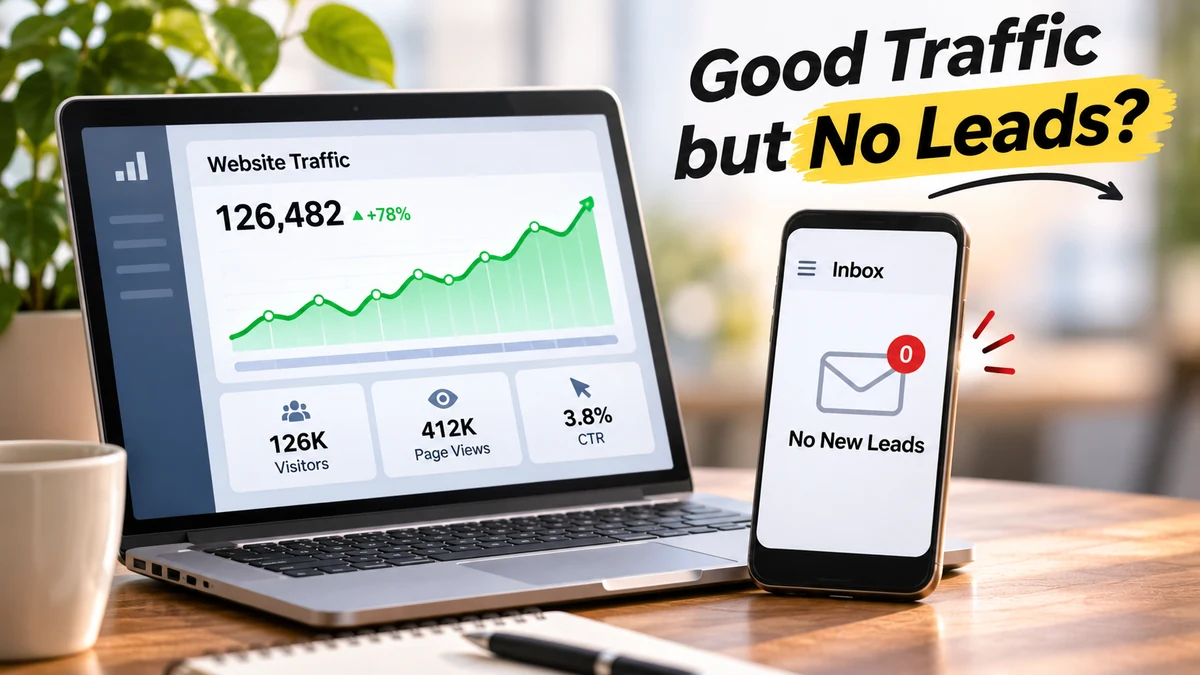
Getting website traffic but no leads is a frustrating place to be. Your analytics show people arriving, sometimes in good numbers. Yet the contact form stays quiet, and the phone barely rings. It’s tempting to think you need more traffic. Usually, you don’t.
In most cases, the problem sits between the visit and the enquiry. That’s actually good news, because these issues are usually quicker and cheaper to fix than traffic. Below are the reasons I see most often, with a fix for each.
1. The visitors aren’t potential customers
Not every visitor could become a customer. A popular blog post might attract students, job seekers or people hunting for free tips. They read, they learn and they leave. That isn’t a failure, but it isn’t a sales channel either.
The fix: check which pages bring in the most visitors. Then ask honestly whether those readers would ever buy from you. If not, create more content for people close to buying. Pricing pages, comparisons, buying guides and strong service pages all help.
2. It isn’t clear what you do
People decide within seconds whether they’re in the right place. A homepage that opens with “Welcome to our website” gives them nothing. Neither does a vague slogan. Many visitors leave before they even scroll.
The fix: at the top of the page, say what you do, who it’s for and why you’re different. Use the words a customer would use. “Bookkeeping for restaurants in Texas, in your time zone” may feel plain. However, it’s far more useful than a clever slogan.
3. There’s no obvious next step
Every important page should make the next step obvious. If your only contact option is a small footer link, most people won’t find it.
The fix: give each key page one clear call to action. That might be a free quote, a short call or a sample. Use the same wording across the site. Also make sure the button is easy to tap on a phone.
4. The form asks for too much
Long forms put people off. Each extra field is one more reason to close the tab and “come back later.” Of course, later usually means never.
The fix: ask only for what you need to reply. That’s usually a name, an email address and a short message. One or two quick dropdowns are fine. Everything else can wait until they’ve written to you.
5. Nothing on the page builds trust
People are wary of contacting a business they know nothing about. Without reviews, names, photos or examples, visitors have little reason to believe you.
The fix: add whatever you honestly can. For instance:
- a few client reviews, with names if clients agree
- a real photo and short background on your About page
- examples of your work, or a brief case study
- certifications that matter in your field
Even two or three genuine reviews make a clear difference.
6. Visitors can’t guess your prices
Many people leave because they can’t tell whether they can afford you. So they quietly assume they can’t.
The fix: you don’t need a full price list. A simple line helps, though. “Packages start at $449 a month” works. So does “Most projects cost $800 to $1,500.” Either gives people enough to decide whether to get in touch.
7. The site is slow or awkward on a phone
A large share of visitors now arrive on their phones. They have little patience for slow pages, tiny text or buttons that are hard to tap.
The fix: open your site on your own phone, then try to contact yourself. Anything that annoys you will annoy visitors too. Meanwhile, smaller images and fewer heavy plugins often speed things up more than you’d expect.
8. Your content never mentions how you can help
A helpful blog post that never links to your services leaves money on the table. Readers get their answer, and then they go.
The fix: end relevant posts with one short, natural line about your service, plus a link. There’s no need for a hard sell. “If you’d like help with this, here’s what I do” is enough.
9. Enquiries arrive, but nobody follows up
Sometimes the leads are coming in after all. However, they land in a spam folder, or an inbox nobody checks. This happens more often than you’d think.
The fix: send a test message through your own form today, and make sure it arrives. Then aim to reply to real enquiries within one working day. The first business to respond often wins the job.
Where to start
Not sure which of these applies to you? Try this quick check:
- Find your three most-visited pages.
- Open each one on your phone.
- Ask three questions. Is it clear what you do? Is there a reason to trust you? Is the next step obvious?
Fix whatever is missing on those three pages first. That’s usually where the quickest wins are.
FAQ
How much traffic do I need before I get leads? It depends on your industry and prices. A specialist service can get good leads from a few hundred focused visitors a month. A low-priced product, by contrast, needs far more. The quality of traffic matters more than the amount.
Should I focus on blog posts or service pages? For leads, start with service pages. That’s where people decide whether to contact you. Blog posts bring people in, and service pages turn them into enquiries.
Is live chat worth adding? Only if someone can answer it quickly. A chat box that nobody replies to does more harm than good.
Want a second pair of eyes on your site? Send me a message with your web address, or read about my SEO audits. I’ll tell you the first three things I’d fix.