


Steal Like an Artist by Austin Kleon: What This Book Teaches Writers About Creativity
- September 21, 2026
- by
- Biswajit Mohanty
Coming up with an original idea can feel surprisingly difficult.
Writers often sit in front of a blank page.
They wait for something completely new to appear.
That pressure can make writing harder than it needs to be.
Austin Kleon’s Steal Like an Artist approaches creativity from another direction.
The book argues that creative work does not appear from nowhere.
We learn from what already exists.
We collect influences.
We combine ideas.
We experiment.
Then we create something that carries our own perspective.
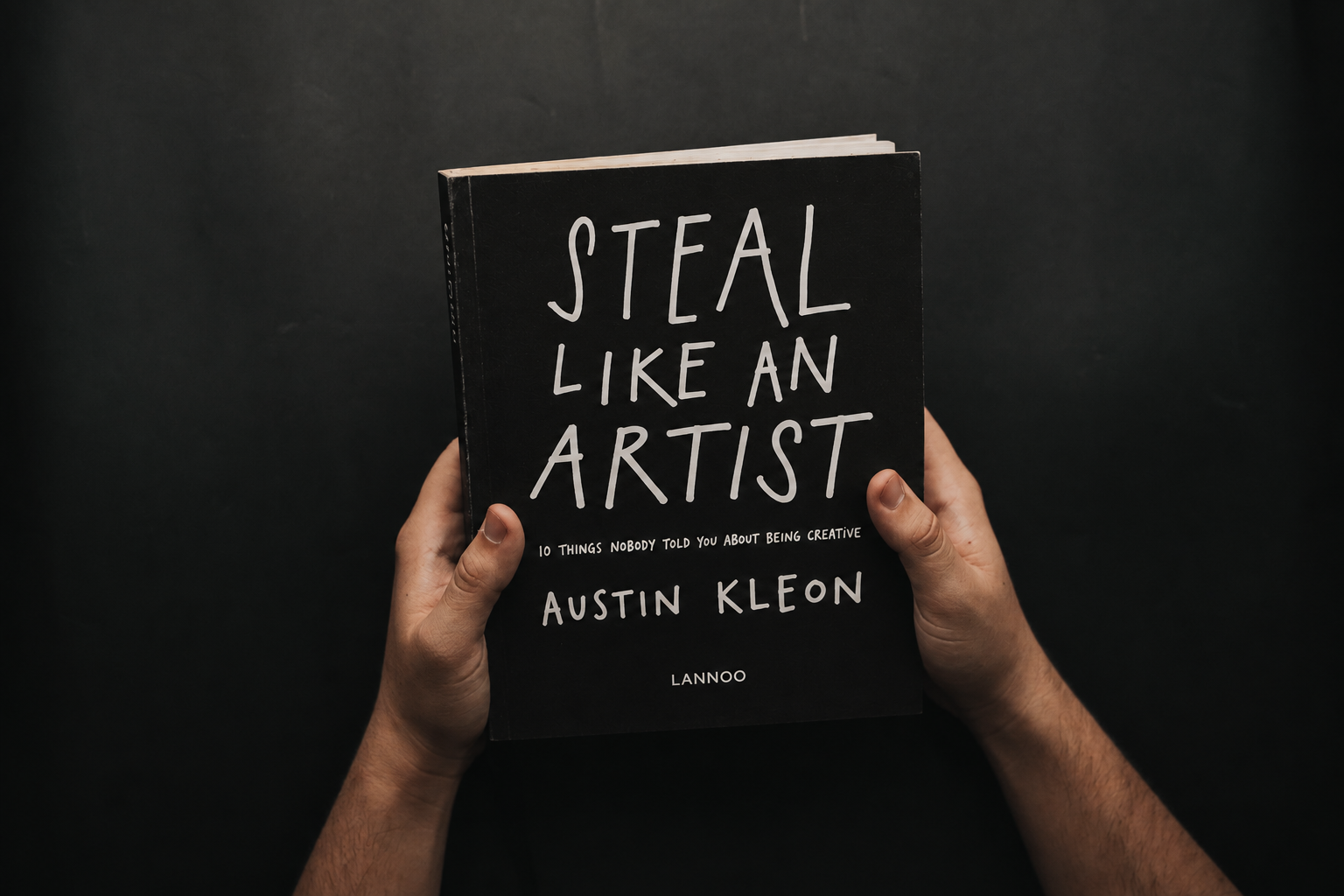
Kleon’s book is short, visual, and easy to read. It was developed from a talk he created for college students in 2011. The talk contained ten ideas he wished someone had shared when he was starting out. (Austin Kleon)
For writers, the interesting question isn’t whether we should literally “steal.”
We shouldn’t.
The interesting question is:
How can we learn from the work around us without losing our own voice?
That’s where this book becomes useful.
What Is Steal Like an Artist About?
Steal Like an Artist: 10 Things Nobody Told You About Being Creative is a book about creativity.
But it isn’t written only for artists.
Kleon’s ideas apply to writers, designers, musicians, photographers, and other creators.
The book explores how creative people gather influences and turn them into new work.
Kleon also challenges the idea that creators must completely invent themselves.
His argument is more practical.
Study the people you admire.
Understand their work.
Collect things that interest you.
Experiment with those influences.
Then develop your own direction.
The author’s official description presents the book as a creativity manifesto for the digital age.
For writers, that makes the book particularly interesting.
Writing already works through influence.
We read.
We observe.
We remember.
We borrow structures.
We learn vocabulary.
We absorb storytelling techniques.
Then we use those experiences when creating our own work.
My Take on Steal Like an Artist
The biggest strength of this book is its simplicity.
Kleon doesn’t make creativity sound mysterious.
He makes it feel practical.
That matters because writers often overthink creativity.
We ask:
“Is this idea original enough?”
Sometimes that question becomes a problem.
We become so worried about originality that we never begin.
Kleon’s approach removes some of that pressure.
It doesn’t tell you to copy someone else’s work.
Instead, it encourages you to study your influences and transform what you learn.
That distinction is important.
A recent writing-focused review makes the same distinction. It describes the book’s central idea as collecting influences and combining them in new ways rather than copying them directly.
For me, that’s one of the book’s most useful lessons.
1. You Don’t Need to Create From Nothing
One of the book’s central ideas is that creative work builds on earlier work.
Think about writing.
A writer might read:
- novels
- essays
- poetry
- journalism
- biographies
- blogs
- research papers
All of those experiences become part of the writer’s creative background.
You don’t write in a vacuum.
Your experiences influence your vocabulary.
Your reading influences your structure.
Your interests influence your subjects.
Your life influences your perspective.
The goal isn’t to pretend those influences don’t exist.
The goal is to understand them.
Then develop something that reflects your own combination of influences and experiences.
2. Inspiration Is Something You Can Collect
This is particularly useful for bloggers.
Ideas don’t always arrive while you’re sitting at your desk.
Sometimes they appear while reading.
Sometimes they appear during conversations.
Sometimes they come from an unusual question.
Sometimes another article triggers a completely different thought.
Kleon’s approach encourages creators to pay attention to those inputs.
A practical system can help.
Create a simple folder called:
Ideas
Inside it, save:
- Interesting headlines
- Questions people ask
- Useful quotes
- Article structures
- Interesting observations
- Book passages
- Screenshots
- Research notes
- Your own unfinished ideas
This becomes your personal idea bank.
You don’t need to use everything.
You simply need somewhere to keep potentially useful material.
3. Read More Than You Write
This is an important lesson for writers.
Writing improves when your input improves.
That means reading shouldn’t be treated as separate from writing.
Read writers you admire.
Read writers you disagree with.
Read outside your normal subject.
If you write about technology, read history sometimes.
If you write fiction, read essays.
If you write SEO content, read excellent journalism.
Unexpected connections can produce interesting ideas.
The book’s emphasis on collecting influences fits naturally with this approach.
Other writers have also highlighted reading and collecting ideas as practical parts of Kleon’s creative philosophy.
4. Study Writers You Admire
Writers often say:
“I want to develop my own style.”
That’s a good goal.
But style doesn’t appear overnight.
One way to understand your own style is to study other writers.
Pick three writers you genuinely enjoy.
Then examine their work.
Ask:
- How do they begin?
- How long are their paragraphs?
- How do they explain ideas?
- How do they use examples?
- How do they create rhythm?
- How do they end sections?
- What makes their voice recognizable?
You’re not copying their sentences.
You’re studying their decisions.
That distinction matters.
5. Learn Through Imitation
This is one of the ideas that needs careful interpretation.
Studying another writer’s technique can teach you something.
Copying their published work and presenting it as your own is plagiarism.
Those are completely different things.
You can imitate a technique during practice.
For example, you might study how a writer builds a short introduction.
Then write your own introduction about a completely different subject.
The exercise teaches you structure.
Eventually, you stop consciously thinking about the technique.
It becomes part of your writing toolkit.
A discussion with Kleon in the Kenyon Review also explores this distinction between learning from influences and simply taking something without transformation.
6. Write About What You Actually Care About
This sounds obvious.
It isn’t.
Many bloggers choose topics only because they appear profitable.
That can make the writing feel lifeless.
Interest creates another advantage.
When you genuinely care about a subject, you usually investigate it more deeply.
You notice details.
You ask better questions.
You find unusual connections.
That can make the finished article more useful.
For example, instead of writing:
“10 Writing Tips”
you might explore:
“Why Writing Every Day Doesn’t Work for Every Writer”
The second idea gives you something to investigate.
It creates room for an argument.
That’s often where better writing begins.
7. Your Hobbies Can Feed Your Writing
One of the ideas I particularly like is the value of side projects.
Your main work doesn’t have to provide every creative experience.
A hobby can give your mind different material.
A writer might:
- Take photographs
- Draw
- Play chess
- Travel
- Cook
- Read history
- Learn music
- Keep a journal
Those activities may seem unrelated to writing.
They aren’t necessarily unrelated.
They give you experiences.
Experiences become observations.
Observations can become ideas.
Ideas can eventually become writing.
A current review of the book also highlights Kleon’s argument that side projects and hobbies can contribute to creative work.
8. Don’t Wait Until You Feel Like a Writer
This may be one of the most practical lessons in the book.
Many people wait for permission.
They think:
“I’ll start writing seriously when I’m better.”
But improvement comes from doing the work.
You learn by writing.
Then you write again.
You notice problems.
You correct them.
You write again.
Eventually, your identity catches up with your practice.
You don’t need to call yourself a writer before writing.
You can simply start.
Kleon’s official list includes the idea of beginning before you have completely figured out your identity.
9. Use Your Hands Sometimes
This idea can seem unusual in a world dominated by screens.
Writers spend enormous amounts of time inside digital documents.
Sometimes that creates distance from the physical act of making something.
Try writing by hand.
Sketch an outline.
Draw a mind map.
Write possible headlines on paper.
Create a messy list of ideas.
The purpose isn’t to reject computers.
It’s to change the way you think.
A different physical process can make familiar ideas feel different.
Kleon’s book explicitly includes working with your hands among its ten principles.
10. Share the Work
Creating something privately can feel safe.
Publishing it feels different.
Once you share your work, people can respond.
Some responses will be useful.
Some won’t.
But publishing gives your work a chance to exist outside your head.
For bloggers, this lesson is especially relevant.
Don’t wait until your website has hundreds of articles.
Publish useful work.
Improve it.
Learn from readers.
Write another article.
Build the body of work gradually.
Kleon’s official framework includes doing good work and sharing it with people.
What Writers Can Learn From the Book
After looking beyond the individual principles, I think the book offers five broader lessons for writers.
1. Originality Doesn’t Mean Isolation
You don’t need to avoid influences.
You need to understand them.
Your voice develops through the combination of your experiences, interests, reading, and choices.
2. Creativity Needs Input
If you consume nothing, you have less material to work with.
Read.
Observe.
Listen.
Research.
Travel.
Talk to people.
Pay attention.
Then make something from what you’ve gathered.
3. Consistency Beats Waiting for Inspiration
Inspiration is useful.
It isn’t reliable.
A writing practice gives creativity somewhere to happen.
You don’t need to feel inspired before beginning.
Sometimes beginning creates the inspiration.
4. Your Perspective Is Part of the Work
Two writers can study the same subject.
They can read the same research.
They can discuss the same book.
Their articles can still feel completely different.
Why?
Because they bring different experiences and perspectives.
That’s something you cannot copy.
5. Creativity Requires Selection
Collecting ideas isn’t enough.
You also need to choose.
Which ideas matter?
Which ones fit together?
Which ones should you ignore?
Which ones deserve more research?
Creativity isn’t just producing possibilities.
It’s deciding what deserves your attention.
Where Steal Like an Artist Falls Short
A good review shouldn’t only praise the book.
Steal Like an Artist is deliberately simple.
That’s one of its strengths.
It’s also one of its limitations.
If you’re looking for a detailed writing course, this isn’t one.
The book doesn’t provide an extensive system for:
- Story structure
- Grammar
- Character development
- Editing
- Publishing
- Research
- SEO writing
- Building a writing career
It also doesn’t explore every creative problem in depth.
Some readers may find the advice familiar.
Others may find the presentation too lightweight.
One review, for example, praises its accessibility while noting that it is not especially long or academically deep.
That criticism is fair.
But depth isn’t necessarily the book’s purpose.
It’s more like a creative reset.
It gives you ideas to think about.
Then you decide what to do with them.
Is Steal Like an Artist Worth Reading?
If you’re a writer, blogger, artist, or other creator, the book offers several useful ideas.
But your expectations matter.
Don’t pick it up expecting a complete writing manual.
It’s not that.
Instead, expect:
- Short chapters
- Visual presentation
- Simple creative principles
- Practical reminders
- Encouragement to make things
- Ideas about influence and originality
You can read it quickly.
The bigger question is whether the ideas stay with you.
For me, that’s where the book has value.
Some books teach you a complicated system.
Others change the question you’re asking.
Steal Like an Artist belongs more to the second group.
Who Should Read Steal Like an Artist?
Beginner writers
It can help remove some of the pressure around originality.
Bloggers
It encourages curiosity and collecting ideas.
Creative professionals
The book offers a simple framework for thinking about influences.
People experiencing creative blocks
Its emphasis on starting and gathering input can provide a useful reset.
Experienced writers
You may already know many of these ideas.
But familiar ideas can still be useful reminders.
Who Might Not Enjoy It?
You may want something else if you’re looking for:
- Advanced writing instruction
- Academic research on creativity
- Detailed fiction techniques
- Grammar instruction
- Publishing advice
- A comprehensive writing course
In those cases, a specialized writing book may serve you better.
Steal Like an Artist and the Problem With “Original Ideas”
This is perhaps the biggest idea worth taking away.
Writers sometimes believe every article must contain an idea nobody has ever considered.
That’s an impossible standard.
Almost every subject has already been discussed.
The opportunity is somewhere else.
You can:
See an old idea differently.
Explain it more clearly.
Connect two ideas that are rarely connected.
Apply an old idea to a new situation.
Bring your own experience into the discussion.
That’s where originality can become practical.
You don’t need to invent a completely new subject.
You need to contribute something of your own.
How I Would Apply the Book to Writing Today
If I took the book’s ideas and turned them into a writing routine, I’d keep it simple.
Read
Read something outside your usual subjects.
Collect
Save ideas that make you curious.
Connect
Look for relationships between those ideas.
Create
Turn one connection into something useful.
Publish
Put the work where people can find it.
Repeat
Do the process again.
That creates a creative cycle.
Input → Ideas → Connections → Writing → Publishing → More Input
You don’t need to wait for a perfect idea.
You need to keep the cycle moving.
Final Thoughts
Steal Like an Artist is a small book with a big central question:
Where do creative ideas actually come from?
Kleon’s answer is reassuring.
They don’t appear from nowhere.
They grow from everything we read, see, experience, study, and remember.
That doesn’t give us permission to copy.
It gives us permission to learn.
For writers, that distinction matters.
Study the writers you admire.
Read widely.
Collect interesting ideas.
Experiment with different forms.
Write about things you care about.
Then add something that could only come from your perspective.
That’s perhaps the most useful way to understand the book’s title.
Don’t steal someone’s work.
Steal the curiosity that makes you want to create your own.
Frequently Asked Questions
What is Steal Like an Artist about?
Steal Like an Artist is Austin Kleon’s book about creativity and making things. It explores influence, experimentation, creative habits, and sharing your work.
Is Steal Like an Artist useful for writers?
Yes. Its ideas about reading, collecting influences, starting before feeling ready, and developing your own perspective can apply directly to writing.
Does Steal Like an Artist encourage plagiarism?
No. The book’s idea is about learning from influences and transforming what you learn. It should not be interpreted as permission to copy or publish someone else’s work as your own.
Is Steal Like an Artist good for beginner writers?
Its simple format can make it accessible to beginners. It focuses more on creative thinking than technical writing instruction.
How long does Steal Like an Artist take to read?
It is a relatively short and visually presented book. Many readers can finish it quickly, although the value comes from applying its ideas afterward.
What is the main lesson of Steal Like an Artist?
One central lesson is that creative work grows from influences. Writers can study what inspires them, transform those influences, and develop their own perspective.
Is Steal Like an Artist better than On Writing?
They serve different purposes. Steal Like an Artist focuses on creativity and creative practice. On Writing combines memoir with advice about writing craft. The better choice depends on what the reader wants from the book.

You may also Like
Bird by Bird by Anne Lamott: What This Book Really Teaches About Writing