
Everybody Writes by Ann Handley: A Practical Guide for Beginner Writers
- October 09, 2026
- by
- Biswajit Mohanty
Writing is one of those skills that can feel simple until you sit down to do it. You may know what you want to say, but turning that idea into a clear introduction, a useful paragraph, or an article people actually want to read is another challenge.
For beginner writers, the difficulty is not always a lack of ideas. Sometimes it is not knowing where to begin, how to organise thoughts, or when a draft is ready to be revised.
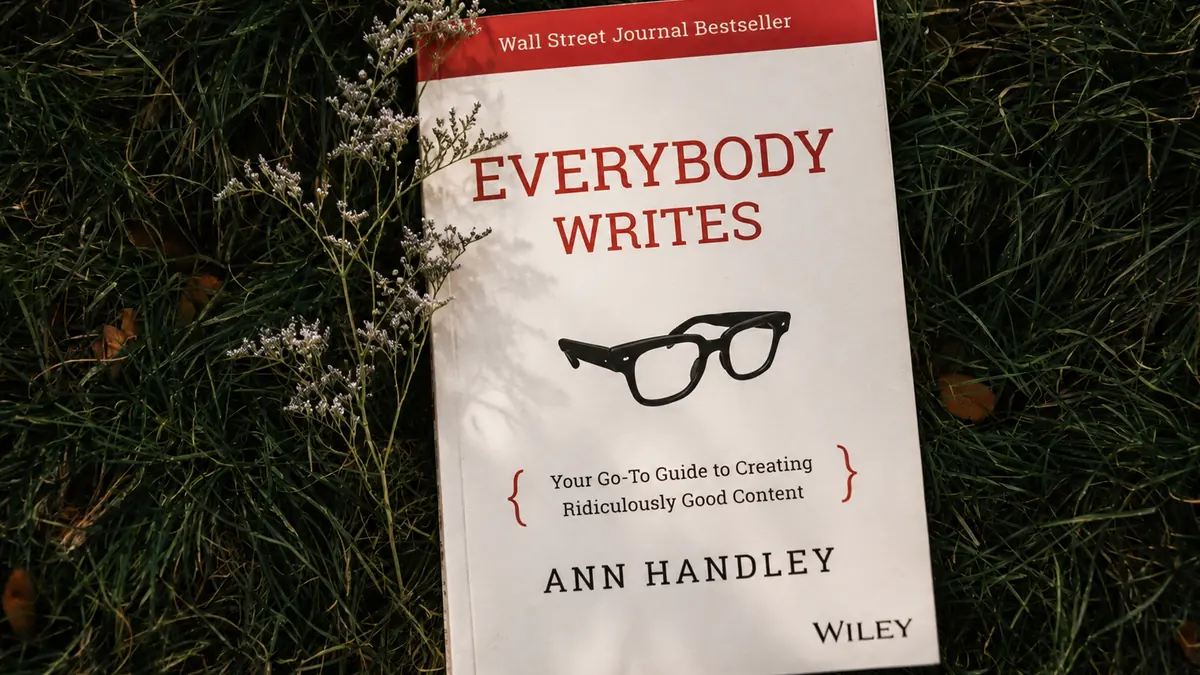
Ann Handley’s Everybody Writes: Your New and Improved Go-To Guide to Creating Ridiculously Good Content approaches writing as a skill that can be developed through practice, a clear process, and greater attention to readers. The book focuses particularly on professional and digital content, making it relevant to people who write blog posts, website copy, emails, and other forms of online communication.
But what can a beginner learn from Everybody Writes? And is it the right book for someone who wants to become a more confident, effective writer?
What Is Everybody Writes About?
Everybody Writes is a practical guide to creating better content. Ann Handley explores the writing process, developing a recognisable voice, choosing words carefully, organising ideas, and adapting writing to different formats.
The book’s central premise is straightforward: writing is not a skill reserved for novelists, journalists, or people who have always considered themselves talented writers. Anyone who communicates through words can benefit from learning to write more effectively.
The second edition, published in October 2022, expands the book’s guidance on content creation, production, and publishing. It includes an updated writing framework, additional examples, and advice covering different kinds of content.
This makes the book particularly relevant to people who write for an audience rather than only for personal expression. If you run a blog, manage a website, work in marketing, or want to build a career around content, many of its themes apply directly to your work.
1. Writing Is a Skill You Can Develop
One of the most useful ideas behind Everybody Writes is that becoming a better writer involves practice rather than waiting for natural talent to appear.
Beginners sometimes divide writers into two groups: people who can write and people who cannot. This assumption can make every early difficulty feel like evidence that writing is not for them.
A more useful approach is to treat writing as a collection of skills. You can learn to structure an article, write a stronger opening, remove unnecessary words, explain an unfamiliar concept, and recognise when a paragraph is difficult to follow.
These abilities develop at different rates. You might be good at explaining ideas but struggle with introductions. You might have a natural storytelling instinct but need to work on structure. Recognising those differences gives you something specific to practise.
For example, instead of setting a vague goal to become a better writer, choose one skill for your next article. Focus on making the opening clearer, improving the order of your sections, or replacing general statements with concrete examples.
This makes progress easier to recognise.
The practical lesson: Do not treat every weakness as a judgement on your ability. Identify the skill behind the problem and work on it deliberately.
2. Build a Writing Process Instead of Waiting for Inspiration
Inspiration can help you begin, but it is not a dependable plan for completing work.
A blog post may start with an interesting observation, yet that does not automatically give you a useful structure. You still need to decide what the article should accomplish, which points matter most, and how the reader will move from one idea to the next.
Handley’s book emphasises the value of having a writing process. Its second edition includes a framework for moving from an initial idea towards a finished piece, along with guidance on drafting, revising, and considering the reader.
You can apply this principle to a simple blog-writing routine:
- Choose the purpose. Decide what the reader should understand or be able to do after reading.
- Gather useful material. Collect facts, examples, questions, and supporting information.
- Organise the ideas. Arrange them in an order that makes sense.
- Write the first draft. Concentrate on developing the explanation instead of polishing every sentence.
- Revise for clarity. Remove repetition, strengthen weak sections, and improve transitions.
- Check before publishing. Verify facts, links, grammar, formatting, and the overall reading experience.
This is not a universal formula, and different writing projects need different approaches. Its value is that it gives you a starting point when you do not know what to do next.
3. Learn to Accept an Imperfect First Draft
A blank page can be intimidating because it offers endless possibilities. Every sentence could begin in a different way, and every idea seems to demand a decision before you have even started.
The pressure to get everything right immediately can turn writing into a slow process of second-guessing.
The writing process described in Everybody Writes makes room for an imperfect first draft and subsequent rounds of revision. The book’s contents explicitly distinguish the early draft from later work, including cutting unnecessary words and reconsidering the content from the reader’s perspective.
This distinction matters because drafting and editing require different kinds of attention.
During drafting, your main task is to develop the ideas. During revision, you can examine whether those ideas are clear, relevant, well-supported, and arranged effectively.
Imagine writing an article about choosing a website hosting service. Your first draft might repeat the same point about speed in three places or leave a section on pricing underdeveloped. That is not necessarily a reason to abandon the article. It is information about what needs to change.
Once the whole piece exists, those problems become easier to see.
An imperfect draft is not the finished product. It is the material from which the finished product can be made.
4. Write for the Reader, Not Just for Yourself
Writers can become so familiar with a subject that they forget what it feels like to encounter it for the first time.
You may understand a technical term, know why a particular step matters, or remember the background behind an argument. Your reader may have none of that knowledge.
This creates a gap between what you intended to explain and what the reader actually understands.
Handley’s focus on audience and reader-centred communication is especially relevant to professional content. The second edition includes advice on reconsidering a draft from the reader’s perspective and communicating with empathy.
Consider a beginner reading an article about website security. A sentence filled with unfamiliar technical terms might be accurate but difficult to use. A clearer explanation can introduce the concept, explain why it matters, and give an example before moving into more advanced details.
Writing for the reader does not mean making every subject simplistic. It means giving people enough context to follow your reasoning.
Before publishing a piece, ask yourself:
- Is the main point clear?
- Have I explained unfamiliar terms?
- Does each section help answer the reader’s question?
- Have I included examples where an explanation might otherwise feel abstract?
- Can I remove anything that makes the article harder to follow without adding value?
These questions are useful whether you are writing a blog post, a tutorial, a product page, or an email.
5. Make Every Word Work Harder
Longer writing is not automatically more informative. A paragraph can contain many words and still communicate very little.
Beginners often add phrases to make their writing sound more formal or authoritative. They may repeat an idea in slightly different language, use an elaborate expression where a simple one would work, or delay the main point until the end of a sentence.
The result can be writing that feels heavier than the subject requires.
A useful editing exercise is to look for the actual message in each sentence and remove anything that obscures it.
For example:
Before: “It is important to note that users should make sure that they regularly check their website backups.”
After: “Check your website backups regularly.”
The second sentence delivers the instruction directly. In a longer article, the space saved can be used for a useful explanation, a warning, or an example.
Concise writing does not mean reducing everything to short sentences. Some ideas need room to develop, and a mixture of sentence lengths helps writing feel natural. The goal is to remove words that create friction without adding meaning.
For a beginner, this is one of the most practical editing habits to develop: do not ask only whether a sentence is grammatically correct. Ask whether it is doing its job.
6. Develop a Voice That Sounds Like You
A writer’s voice is not simply a collection of favourite expressions or a particular sentence length. It develops through choices about what to notice, how to explain ideas, what examples to use, and how to address readers.
Beginners sometimes try to sound professional by imitating the style of established writers. This can be useful as an exercise, but copying a voice too closely may leave their own writing stiff or unnatural.
Handley’s book addresses brand voice and original storytelling as part of effective content creation.
For a new writer, the practical starting point is to develop a consistent way of communicating rather than searching for a distinctive style in every paragraph.
If your natural strength is explaining complicated ideas in plain language, build on that. If you tend to notice useful details, bring those observations into your examples. If you enjoy a conversational tone, use it where it suits the subject and audience.
Your voice should not become an excuse for unclear writing. A distinctive style still needs to communicate the point.
Over time, reading widely, writing regularly, and revising your own work will help you recognise which choices feel natural and which ones make your writing less effective.
7. Understand That Different Content Needs Different Approaches
A blog post is not an email. An email is not a landing page. A tutorial is not a personal essay.
Although all of them use words, each format has a different purpose and asks something different of its writer.
A tutorial needs a logical sequence that readers can follow. A landing page needs to explain value clearly and guide visitors towards a relevant action. A newsletter may depend more on a personal connection, while a blog article often needs to answer a question in enough depth to be genuinely useful.
Everybody Writes covers a range of content types, which makes this an important part of its appeal for people working with digital communication. The book’s publisher describes guidance for numerous forms of content rather than one narrow writing format.
For beginners, this is a reminder to understand the job a piece of writing needs to do before choosing how to write it.
A useful question to ask is: what does the reader need from this particular format?
Once you know the answer, you can make better decisions about length, tone, structure, examples, and calls to action.
8. What the Book Can Teach Beginner Bloggers
Although Everybody Writes is not exclusively a book about blogging, its approach to content creation is relevant to anyone building a blog.
A beginner blogger needs more than a list of topics. Each article should have a clear purpose, a useful angle, and a structure that helps readers find the information they came for.
For example, an article about choosing a password manager should not simply define password management and list a few features. It should help readers understand which factors matter, how those factors affect their choice, and what limitations they should consider.
This is where writing and research work together. Clear language cannot compensate for inaccurate information, just as accurate information cannot make an article useful if it is badly organised.
A practical approach for a new blogger is to:
- Start with a specific reader problem or question.
- Research the subject and verify important claims.
- Create headings that reflect the article’s actual content.
- Explain the important points in a logical order.
- Use examples to make unfamiliar ideas easier to understand.
- Edit for clarity and remove repetitive sections.
- Check that the finished article delivers what its title promises.
These are practical applications of reader-centred writing and a deliberate writing process, not a substitute for learning research, search intent, or technical SEO.
Does Everybody Writes Help With SEO?
Everybody Writes is primarily a guide to writing and content creation, not a comprehensive search engine optimisation manual. It should not be treated as a complete guide to keyword research, technical SEO, internal linking, or search performance analysis.
However, many of its writing principles are useful when creating search-focused articles.
A search-friendly article still needs to answer the reader’s question clearly. Its headings should help people navigate the subject, its explanations should be understandable, and its examples should add real value rather than simply repeat the target keyword.
For instance, if you are writing about website hosting, you might organise the article around the reader’s actual decisions: performance, reliability, support, pricing, and the needs of the website. That structure can be more helpful than forcing the same keyphrase into every heading.
Good writing and SEO are related, but they are not interchangeable. Search visibility also depends on factors outside the writing itself, including competition, technical accessibility, links, and how well a page satisfies the query.
The value of a book like Everybody Writes is that it can help you improve the content people encounter after they arrive.
What Everybody Writes Does Well
The book’s strongest appeal is its practical focus on the writing process and the needs of readers.
Rather than treating good writing as a mysterious talent, it approaches writing as work that can be planned, drafted, reviewed, and improved. Its coverage of different content formats also makes it relevant beyond traditional creative writing.
For beginners who want to write for the web, this practical orientation is useful. It connects writing decisions with the purpose of the content and the experience of the person reading it.
The emphasis on revision is valuable, too. Many new writers assume that good writing should emerge almost perfectly on the first attempt. A process that allows for drafting and improvement gives them a more realistic way to approach the work.
The book is also relevant to people who write as part of another job or project. You do not have to be a full-time writer to benefit from clearer communication.
Where the Book’s Advice Has Limits
Because Everybody Writes focuses heavily on content and professional communication, it is not the only resource a beginner needs.
Someone who wants to write fiction may need more specialised guidance on character development, dialogue, plot, and narrative structure. A technical writer may need instruction in documentation standards and information architecture. A blogger who wants to improve search performance will still need to learn SEO research and measurement.
The book’s general writing principles can support these activities, but they do not replace specialised knowledge.
It is also important to distinguish learning a process from mastering it. Understanding why a draft needs revision does not automatically make revision easy. Writers still need to practise identifying weak arguments, awkward transitions, unsupported claims, and sections that do not serve the reader.
The best way to use a practical writing guide is to apply its ideas to real work and examine the results. Reading alone cannot replace writing.
Who Should Read Everybody Writes?
Everybody Writes may be a good fit for:
- Beginner bloggers: People who want a more organised approach to planning, drafting, and editing articles.
- Aspiring content writers: Those who want to create clearer website copy, articles, emails, and other professional content.
- Freelance writers: Writers who need to adapt their work to different audiences and formats.
- Small business owners and creators: People who write their own web pages, newsletters, social posts, or product descriptions.
- Writers who lack confidence: Those who want to treat writing as a skill they can practise instead of something they must already be good at.
Readers looking for a dedicated guide to fiction, poetry, or technical SEO may want to pair this book with resources specific to those subjects.
Final Thoughts: Better Writing Begins With Better Habits
Everybody Writes by Ann Handley offers a practical way to think about writing: as a skill that improves through deliberate work, a repeatable process, and attention to the people who will read the finished piece.
For beginners, that perspective can make writing feel more manageable. You do not have to solve every problem at once. You can learn to organise ideas, write a rough draft, revise unclear sentences, and make the reader’s experience a little better with each piece.
The book is particularly relevant if your goal is to write for the web, where clarity, usefulness, tone, and structure all influence how people experience your content.
It will not teach every form of writing, and it cannot replace regular practice. But it offers a useful foundation for people who want to communicate more effectively and take their writing seriously.
You do not need to wait until you feel like an expert to start. Choose a subject, understand your reader, write a first draft, and give yourself the opportunity to improve it.