



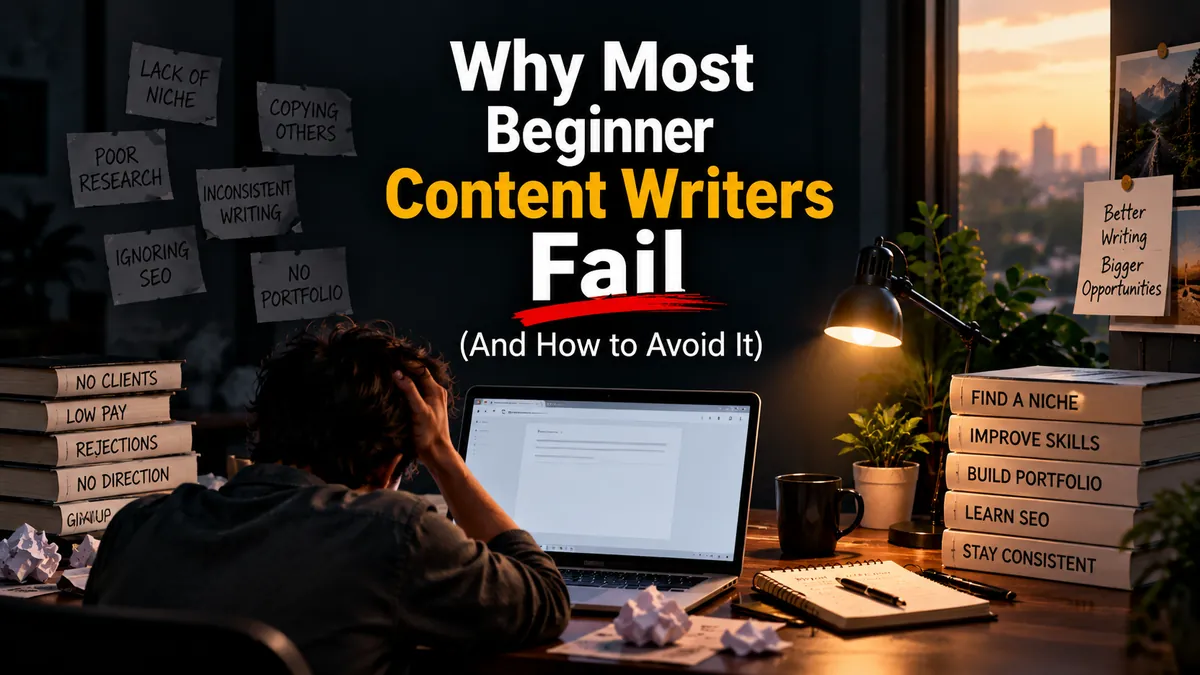
Why Most Beginner Content Writers Fail (And How to Avoid It)
- June 26, 2026
- by
- Biswajit Mohanty
Every year, new people enter content writing.
Some are students looking for a side income.
Some want to become freelancers.
Some want a remote career.
And some simply enjoy writing and hope to turn it into something more.
But here’s something I’ve noticed after working in content writing for more than a decade.
Most beginners don’t fail because they can’t write.
They fail because of their expectations.
That may sound harsh, but hear me out.
Over the years, many beginners have contacted me asking for writing projects. Sometimes they find my profile online. Sometimes they get my number through referrals.
The conversation often starts the same way.
“Sir, do you have any content writing projects?”
I ask them about their experience.
Most of them have little or none.
Then I ask to see their writing samples.
And that’s where the real picture starts becoming clear.
The problem usually isn’t a lack of talent.
The problem is that many people want professional opportunities before they’ve developed professional skills.
I understand why.
When you’re starting out, it’s exciting to imagine getting clients, earning money, and working from home.
But writing, like any skill, takes time to develop.
The people who succeed understand that.
The people who fail often don’t.
Let’s talk about some of the biggest mistakes I’ve seen beginners make over the years.
1. They Expect Results Too Quickly
This is probably the most common mistake.
Many beginners enter content writing expecting quick income.
After watching videos online, they assume they’ll find clients within a few weeks and start earning consistently.
Sometimes that happens.
Most of the time, it doesn’t.
Writing is one of those skills where the early stages can feel frustrating.
You write.
You improve.
You learn.
You make mistakes.
You improve again.
And often nobody notices the progress except you.
The writers who survive this phase usually keep going.
The writers who quit often expect immediate results.
I didn’t become a professional writer overnight.
Neither do most successful writers.
2. They Spend More Time Learning Than Writing
This might sound strange, but it’s something I see constantly.
Beginners watch videos about content writing.
Read articles about content writing.
Listen to podcasts about content writing.
Join groups about content writing.
And then…
They don’t actually write.
Learning is important.
But writing is a practical skill.
You develop it by writing.
Not by endlessly consuming advice.
Think about cricket.
You can watch thousands of videos about batting.
At some point, you still need to pick up the bat.
Writing works the same way.
3. They Want to Learn Everything at Once
Content writing.
SEO.
Digital marketing.
AI tools.
Social media marketing.
Copywriting.
Email marketing.
Personal branding.
Freelancing.
Website development.
I’ve seen beginners try to learn all of these simultaneously.
The result?
They become overwhelmed.
Look, all of those skills are useful.
But you don’t need to master everything in your first month.
Start with writing.
Build a strong foundation.
Then expand gradually.
The internet often makes success look like a sprint.
In reality, most careers are built step by step.
4. They Fear Criticism Too Much
I can relate to this one because I struggled with it myself.
In my early days, feedback affected me more than it should have.
Even when clients accepted my work, there was always a small voice asking:
“What if they don’t like it?”
“What if I made mistakes?”
“What if I disappoint them?”
Over time, I realized something important.
Criticism is not always rejection.
Sometimes criticism is simply guidance.
Every good writer gets edited.
Every good writer receives feedback.
And every good writer makes mistakes.
The goal isn’t to avoid criticism.
The goal is to keep improving despite it.
5. They Read Too Little
This may sound surprising coming from someone who works in digital content, but I genuinely believe reading is one of the biggest advantages a writer can have.
And unfortunately, many beginners don’t read enough.
Some want to become writers without reading books.
Others only consume short social media content.
The problem is that writing and reading are deeply connected.
Every good writer is constantly absorbing ideas, sentence structures, perspectives, and vocabulary from other sources.
When I was younger, I spent a lot of time reading.
Books.
Articles.
Stories.
Essays.
Even today, I learn something from almost everything I read.
Reading expands your thinking.
And expanded thinking usually leads to better writing.
If you want to become a stronger writer, read more than your competitors.
It’s one of the simplest advantages you can create for yourself.
6. They Focus Too Much on Money
Now before anyone misunderstands this point, let me be clear.
There’s nothing wrong with wanting to earn money.
We all work because we need income.
But many beginners make money their only focus.
Every decision becomes:
“How much will I earn?”
“How fast can I earn?”
“Which niche pays the most?”
“Which client pays more?”
The problem is that when money becomes the only priority, skill development often gets ignored.
In the early stages of my career, some of the most valuable opportunities weren’t necessarily the highest-paying ones.
They were the ones that taught me something.
A new industry.
A new style of writing.
A new challenge.
Those experiences helped me grow.
And growth eventually created better opportunities.
The writers who last usually focus on improving first and earning second.
Ironically, that’s often what helps them earn more in the long run.
7. They Depend Completely on AI
AI has become an incredible tool.
I use it.
Most modern writers use it.
And I think every writer should learn how to use it effectively.
But I’ve also noticed a growing problem.
Some beginners try to skip the learning process entirely.
Instead of learning how to write, they learn how to generate content.
There’s a difference.
AI can produce words.
But it can’t replace understanding.
If you don’t know what makes writing good, you won’t know whether the AI output is good either.
Think about it this way.
A skilled writer can use AI and improve the result.
An inexperienced writer often copies the result without knowing what’s wrong with it.
That’s why I always encourage beginners to build their writing skills first.
Then use AI to make those skills more powerful.
Not the other way around.
8. They Don’t Know How to Work With Clients
Writing is only part of the job.
Working with people is equally important.
I’ve seen talented writers lose opportunities because they couldn’t handle client relationships properly.
Sometimes they become defensive when receiving feedback.
Sometimes they argue unnecessarily.
Sometimes they disappear when revisions are requested.
And sometimes they simply fail to communicate clearly.
Clients aren’t just paying for words.
They’re paying for reliability.
Professionalism.
Communication.
Trust.
A writer who communicates well often gets repeat work.
A writer who creates unnecessary conflict often doesn’t.
This is a lesson I learned gradually over the years.
Sometimes being easy to work with is just as important as being good at writing.
9. They Give Up Too Soon
This might be the biggest reason of all.
Many people quit before they become good.
Not because they lack talent.
Not because they lack intelligence.
Not because they lack opportunity.
They quit because progress feels slow.
And honestly, progress usually is slow in the beginning.
Most writers don’t have a dramatic success story.
Most improve quietly.
One article at a time.
One client at a time.
One lesson at a time.
The improvement is often invisible until you look back after a year or two.
That’s why persistence matters so much.
The writers who succeed aren’t always the most gifted.
They’re often the ones who simply stay in the game long enough to improve.
Final Thoughts
After more than a decade in content writing, I’ve become convinced of one thing.
Most beginners don’t fail because they aren’t capable.
They fail because they underestimate the process.
They expect quick results.
They avoid practice.
They fear criticism.
They focus on shortcuts.
Or they give up too early.
The good news is that every mistake in this article can be avoided.
You don’t need to be a genius to become a better writer.
You don’t need perfect grammar from day one.
You don’t need expensive courses.
What you do need is patience.
Curiosity.
Consistency.
A willingness to learn.
And enough persistence to keep going when progress feels slow.
Because the truth is, most successful writers didn’t start out extraordinary.
They simply kept writing when others stopped.
And over time, that made all the difference.

You may also Like


Why Your Blog Posts Aren’t Getting Traffic — Even When They’re Good