

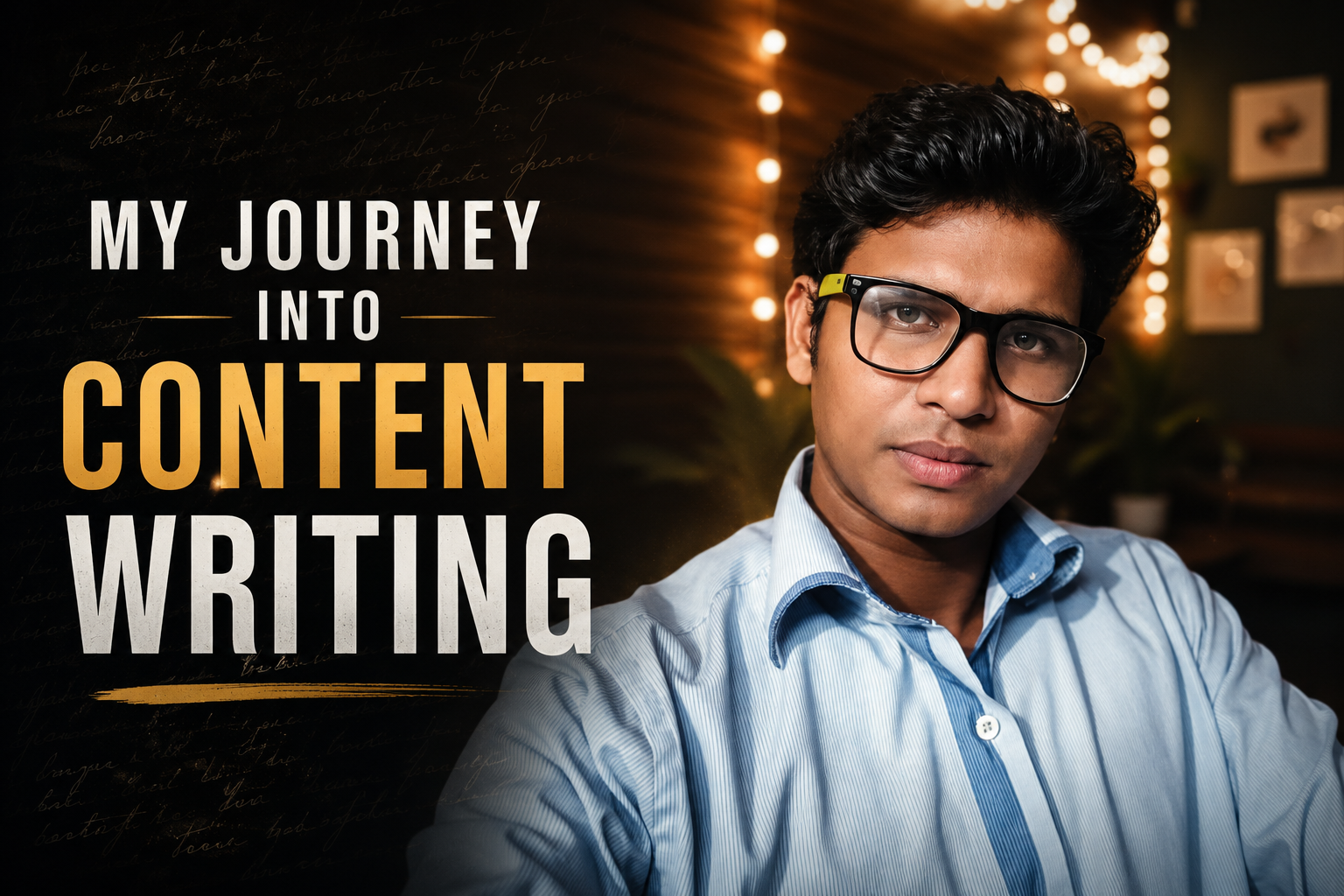
My Journey Into Content Writing: From Writing Poems to Building a Career
- June 11, 2026
- by
- Biswajit Mohanty
People often ask me how I became a content writer.
And honestly, the answer isn’t as straightforward as people expect.
I didn’t wake up one morning and decide to become a writer. I didn’t enroll in a content writing course. I wasn’t chasing a freelancing career. In fact, when I first started writing, I didn’t even know that content writing existed as a profession.
I simply enjoyed writing.
Looking back now, I realize that my journey started long before my first client, long before SEO, and certainly long before AI entered the picture.
It started in a classroom.
When Writing Was Just a Passion
During my school days, I had a literature teacher who was unlike most teachers I had met.
He didn’t just teach literature. He lived it.
Whenever he entered the classroom, lessons would suddenly feel less like lessons and more like stories. He had a way of narrating events, explaining characters, and bringing emotions into the classroom that made students genuinely interested in what he was teaching.
Even today, years later, I can still remember some of those classes.
Around that time, one of my classmates had written a children’s poem. He happened to be related to one of our teachers and showed the poem to our literature teacher.
The teacher praised him.
That’s all it was.
A simple moment.
A teacher appreciating a student’s writing.
But sometimes life changes because of moments that look ordinary to everyone else.
Something about that incident stayed with me.
I remember thinking, “Maybe I can write something too.”
So I tried.
My first attempts weren’t extraordinary. They were simply honest. And that’s probably why writing appealed to me from the beginning. It gave me a place to express thoughts that otherwise stayed inside my head.
At that stage of my life, I was living away from my parents at my uncle’s house so I could continue my studies.
If you’ve ever lived away from home at a young age, you’ll understand the feeling.
You miss people.
You miss familiar routines.
You find yourself thinking about things more deeply than you normally would.
And maybe that’s why many of my early writings were filled with emotions.
I wrote about nature.
I wrote about memories.
I wrote about loneliness.
I wrote about dreams and hopes and small observations that most people probably wouldn’t pay attention to.
There was no internet to help me generate ideas.
No writing software.
No AI tools.
No audience.
Just a notebook, a pen, and a lot of thoughts.
Eventually, I gathered enough courage to show some of my writing to my literature teacher.
To my surprise, he appreciated it.
Looking back, that encouragement mattered more than I realized at the time.
When you’re young, appreciation from someone you respect can stay with you for years. It permits you to believe that maybe you’re not completely terrible at something.
And that’s exactly what happened.
I continued writing.
Not because I wanted a career.
Not because I wanted money.
Simply because I enjoyed it.
Over time, I started experimenting with different forms of writing. I wrote poems in Odia, Hindi, and English. I tried writing short stories. Sometimes I would write about things happening around me. Sometimes I would write purely from imagination.
I wasn’t trying to become a writer.
But writing was slowly becoming a part of who I was.
I just didn’t know it yet.
The Years Before Content Writing
Back then, internet access wasn’t as common as it is today.
You couldn’t instantly search for writing advice, watch tutorials, or publish content everywhere. Most of my writing happened on paper. Pages filled with poems, unfinished stories, random thoughts, and ideas that seemed important at the time.
Some of those writings were probably terrible.
Some were surprisingly decent.
But every page taught me something.
Without realizing it, I was developing habits that would help me years later—observing people, expressing ideas, describing emotions, and learning how words could affect someone reading them.
The funny thing is that none of this felt like preparation for a career.
It just felt like a hobby.
A hobby that I genuinely loved.
A Free Blog, A Lot of Books, and An Unexpected Opportunity
After school and graduation, life entered one of those phases where you know you’re moving forward, but you’re not entirely sure where you’re going.
Our family had shifted to Bhubaneswar by then. I wasn’t doing anything particularly remarkable. Most of my days were surprisingly simple.
I spent a lot of time reading books.
I played cricket with friends.
And whenever I felt like it, I wrote.
That’s it.
There was no grand career plan.
No five-year roadmap.
No vision board telling me where I would be in the future.
Looking back, it might sound like a period of uncertainty. But honestly, it was also one of the most peaceful phases of my life.
I was consuming stories constantly.
Books became a big part of my routine. Some taught me things. Others simply entertained me. But all of them helped shape the way I thought and wrote.
And somewhere during that time, I discovered WordPress.
Not the professional websites people build today.
Just a free WordPress blog.
I created a simple blog called biswajitmohantyblog.wordpress.com and started publishing whatever I felt like writing.
Short stories.
Thoughts.
Observations.
Random pieces of writing.
There was no strategy behind it.
No keyword research.
No SEO.
No content marketing.
I wasn’t trying to build an audience.
I was simply putting my writing out into the world.
And then something happened that completely changed the direction of my life.
A friend of mine was already working in the digital marketing industry. One day, he came across one of my short stories.
After reading it, he said something that I had never seriously considered before.
“You write well. You can actually earn from this.”
I still remember that conversation.
Not because it sounded unbelievable, but because until that moment, writing and earning money existed in two completely different worlds inside my head.
Writing was something I loved.
Money came from jobs.
The idea that writing itself could become work had never crossed my mind.
But once that seed was planted, I became curious.
How do people earn through writing?
Who pays writers?
What kind of writing do businesses need?
At that point, I knew almost nothing about content writing as a profession.
And honestly, that’s where the real journey began.
My First Professional Writing Projects
In 2015, that same friend introduced me to someone working as an SEO manager in a startup SEO company.
That introduction became my first real opportunity.
I wasn’t applying through freelancing platforms.
I wasn’t sending hundreds of proposals.
I simply got a chance because someone believed I could write.
Looking back, I realize how important referrals can be.
Sometimes opportunities arrive because of skill.
Sometimes they arrive because of relationships.
Most of the time, they arrive because of both.
The SEO company started giving me content projects.
For the first time, I wasn’t writing just because I felt like writing.
I was writing for clients.
Real clients.
Real deadlines.
Real expectations.
And trust me, that’s a completely different experience.
Writing for yourself is comfortable.
Writing for someone who is paying you changes everything.
Suddenly, your writing needs to solve a problem.
It needs to communicate clearly.
It needs to match expectations.
And most importantly, it needs to be delivered on time.
I learned those lessons very quickly.
The company worked with different clients, many from India and many from outside India. Because of that, I got exposed to a wide variety of topics and industries.
One week I might be writing about health.
The next week, technology.
Then education.
Then business.
Then something completely unfamiliar.
At the time, I didn’t realize how valuable this experience would become.
Writing across different niches forced me to learn quickly.
It also taught me one of the most important lessons of my career.
A lesson that completely changed the way I wrote.
And it came from a mistake I was making myself.
The Mistake of Trying to Sound Smart
Like many beginners, I made a mistake that I see new writers making even today.
I thought good writing meant using big words.
The more sophisticated the vocabulary sounded, the better the writing must be… or so I believed.
So whenever I wrote an article, I would try to make it sound “professional.”
I would use fancy words.
Long sentences.
Complicated expressions.
Sometimes I would spend more time trying to sound intelligent than trying to communicate the actual message.
And honestly, when I look back now, some of that writing feels exhausting to read.
The funny thing is that I wasn’t doing it intentionally.
I genuinely believed that’s how professional writers wrote.
After all, if you’re getting paid to write, shouldn’t your writing sound advanced?
Well… not really.
After a few months of writing professionally, something became very obvious.
The articles that readers understood easily performed better.
The articles that clients liked most were usually the ones written in a simple and straightforward way.
The content that created the most impact wasn’t the content that sounded intelligent.
It was the content that communicated clearly.
That realization changed everything for me.
I started paying more attention to readability.
I began shortening sentences.
I removed unnecessary words.
I stopped trying to impress readers and started trying to help them understand.
And that’s a lesson that has stayed with me throughout my career.
Even today, whenever I edit content, I ask myself a simple question:
“If an average reader lands on this page, will they understand what I’m trying to say?”
Because writing isn’t about showing people how many words you know.
It’s about helping people understand something.
The simpler the message, the stronger the connection.
At least that’s what more than a decade of writing has taught me.
Learning the Craft One Project at a Time
As the projects kept coming, I slowly started understanding that content writing wasn’t just about writing.
Research mattered.
Understanding the audience mattered.
Formatting mattered.
Deadlines mattered.
Client expectations mattered.
And perhaps most importantly, adaptability mattered.
Every client wanted something different.
One client preferred detailed articles.
Another wanted concise website content.
Some wanted formal language.
Others preferred a conversational tone.
There was no single formula that worked everywhere.
The more projects I completed, the more I realized that writing was only one part of the job.
Understanding people was equally important.
And because the SEO company worked with clients from different industries, I found myself learning about subjects I had never imagined writing about.
Some projects were enjoyable.
Some were challenging.
And some forced me to spend hours researching topics that were completely new to me.
But that’s one of the hidden benefits of content writing.
You never stop learning.
One day, you’re reading about healthcare.
The next day, you’re learning about software.
Then education.
Then digital marketing.
Then science.
Then something entirely different.
Every project teaches you something.
And over time, you start becoming comfortable with uncertainty.
You stop being afraid of unfamiliar topics because you trust your ability to research and learn.
Looking back, those early years gave me something more valuable than income.
They gave me confidence.
Not confidence that I knew everything.
Confidence that I could learn anything if I was willing to put in the effort.
The Fear of Criticism
There was another challenge I rarely talked about.
And if you’re a writer, you might relate to this.
In my early years, criticism affected me more than it should have.
Even though most of my content was accepted by clients and rarely rejected, there was always a small fear in the back of my mind.
“What if the client doesn’t like it?”
“What if they think it’s not good enough?”
“What if I missed something important?”
The strange thing is that these thoughts often appeared before any actual criticism existed.
It was mostly insecurity.
And insecurity can be surprisingly loud when you’re starting out.
Sometimes I would overthink feedback.
Sometimes I would take criticism personally.
Sometimes I would spend too much time worrying about things that never happened.
With experience, I learned something important.
Clients are usually not attacking you.
They’re trying to improve the project.
The sooner a writer separates feedback from personal identity, the easier the work becomes.
Today, I still value feedback.
But I no longer fear it the way I once did.
Because every strong writer eventually realizes that improvement often comes from the feedback we don’t want to hear.
Freelancing Platforms, and Expanding My Horizons
As my experience grew, I started exploring more opportunities outside the projects I was getting through referrals.
Like many writers during that time, I created profiles on freelancing platforms.
I worked on platforms such as Guru, Freelancer, and Upwork. The freelancing world was very different back then. Competition existed, of course, but it didn’t feel as crowded as it does today.
Clients were actively searching for writers.
Writers were trying to build credibility.
And every completed project felt like another step forward.
I won’t pretend that every project was exciting.
Some projects were routine.
Some paid less than I would have liked.
Some required far more research than expected.
But every project taught me something.
And when you’re building a career, that’s often more important than people realize.
One platform that played a significant role in my journey was Contentmart.
Many writers today may not even remember it, but at the time it was one of the popular content-writing platforms in India.
I worked with several clients there and gradually built my profile.
Eventually, I became a verified writer with a rate of around ₹2 per word, which felt like a major achievement at that stage of my career.
It wasn’t just about the money.
It was validation.
For someone who had started by writing poems in notebooks, seeing clients willingly pay for my words felt rewarding.
It showed me that writing could be more than a hobby.
It could become a profession.
Joining a VoIP Software Company
Around 2017, another important chapter began.
I joined a VoIP software company.
Initially, my work was more freelancing-oriented, but over time I became more deeply involved with the company and its content requirements.
This experience introduced me to a completely different side of writing.
Until then, much of my work had been general content writing, blog writing, and SEO-focused projects.
Now I was dealing with technical content.
Software content.
Industry-specific information.
Documentation.
Website content.
Product-related articles.
And trust me, technical writing teaches you humility very quickly.
When you’re writing about technology, you can’t rely on beautiful language alone.
You need to understand the subject.
You need to research carefully.
And most importantly, you need to explain complex ideas in a way that ordinary readers can understand.
That challenge helped me grow significantly as a writer.
I learned how to simplify technical concepts without losing accuracy.
And that’s a skill I still value today.
The Unexpected Classroom Called Quora
Around the same period, I started writing on Quora.
At first, it was simply a platform where I shared thoughts and answered questions.
I wasn’t expecting much from it.
But something interesting happened.
People started reading.
Then more people started reading.
And before I knew it, my answers were reaching audiences far beyond anything I had experienced before.
One of the biggest advantages of Quora was that it allowed me to write about subjects I genuinely enjoyed.
Not client topics.
Not assigned projects.
Topics that fascinated me personally.
I wrote about:
- politics
- philosophy
- spirituality
- physics
- writing
- Odisha
- current affairs
- social issues
Sometimes I would spend hours thinking about an answer before publishing it.
Not because someone was paying me.
Simply because I enjoyed the discussion.
Over time, my audience grew.
There was a period when I became one of the most viewed political writers on the platform and ranked among the top contributors in that category.
That experience taught me something extremely valuable.
Writing for readers is different from writing for clients.
Clients care about business goals.
Readers care about connection.
They care about whether your words make them think, learn, agree, disagree, laugh, or reflect.
Quora became an unexpected classroom for me.
It taught me audience psychology.
It taught me engagement.
It taught me how people react to ideas.
And perhaps most importantly, it taught me that writing is not just about information.
It’s about communication.
Some of the lessons I learned on Quora later helped me tremendously in content writing, marketing, and even client projects.
Looking back now, I don’t think many writers realize how valuable it is to write publicly.
When thousands of real people are reading your work, you learn very quickly what connects and what doesn’t.
And those lessons stay with you for years.
The Years That Taught Me the Most
If the years between 2015 and 2019 helped me become a better writer, the years that followed taught me how content fits into the real world.
By then, I wasn’t just writing articles anymore.
I was working with different businesses, startups, agencies, and marketing teams. And that’s when I started seeing content from a completely different perspective.
Many beginners think content writing is only about writing blog posts.
I used to think that too.
But content is everywhere.
It’s in social media posts.
It’s in advertisements.
It’s in landing pages.
It’s in email campaigns.
It’s in product descriptions.
It’s even in the small pieces of text that most people never notice.
The more projects I worked on, the more I realized that writing was only one part of a much bigger ecosystem.
During those years, I had the opportunity to work with businesses from very different industries.
Some projects involved website content.
Some involved social media campaigns.
Others involved content marketing strategies where the goal wasn’t just to write something well but to help a business communicate effectively with its audience.
I worked with startups trying to build their presence.
I worked with established businesses looking to improve their content.
And every project came with its own challenges.
One project that I still remember was a food delivery startup.
Like many startups, the team was energetic, ambitious, and full of ideas. We worked on content, social media communication, and marketing efforts.
But despite all the effort, the company couldn’t survive for long.
Within a few months, it shut down.
At the time, it was disappointing.
But it also taught me an important lesson.
Good content can help a business grow.
But content alone cannot save a business that struggles with larger challenges.
That lesson stayed with me.
Around the same period, I also worked on projects related to political campaigns, renewable energy companies, and various digital marketing initiatives.
Every industry had its own language.
Its own audience.
Its own way of communicating.
And that’s what made the work interesting.
One day I would be writing about technology.
Another day renewable energy.
Then social media campaigns.
Then business communication.
Then website content.
The variety kept me learning.
And honestly, that’s one of the reasons I never got bored of writing.
Every project felt like entering a new world.
Then Everything Changed
For many years, the content writing industry evolved gradually.
New platforms appeared.
SEO practices changed.
Social media became more important.
Marketing strategies evolved.
But the basic idea remained the same.
Businesses needed writers.
Writers created content.
Then AI arrived.
And suddenly, everything changed.
I still remember the first time I saw AI generate content that looked surprisingly usable.
Like many writers, my first reaction was curiosity.
Then came concern.
Then came experimentation.
And eventually, acceptance.
Today, people often ask me whether AI is good or bad for writers.
My answer is usually the same.
It’s both.
AI is one of the most powerful writing tools I have ever seen.
It can help generate ideas.
Speed up research.
Create outlines.
Improve productivity.
Help overcome writer’s block.
And when used properly, it can save an enormous amount of time.
But at the same time, it has changed the economics of content writing.
Many businesses that previously hired writers for every small task now rely on AI-generated content.
Some companies have reduced writing budgets.
Some writers have lost projects.
And many beginners are entering a market that looks very different from the one I entered in 2015.
The reality is that content writing has become more competitive.
There’s no point pretending otherwise.
But here’s what I’ve observed.
The writers who continue to thrive are usually not the ones fighting against AI.
They’re the ones learning how to use it intelligently.
Because AI can generate words.
It can generate structure.
It can generate information.
What it still struggles to generate consistently is experience.
Perspective.
Judgment.
Original thought.
Human observation.
The little details that come from actually living through something.
That’s why I still believe good writers have a place in the future.
The role is changing.
The tools are changing.
But the need for genuine communication hasn’t disappeared.
If anything, it has become more valuable.
Because when everyone can generate content, the ability to create meaningful content becomes even more important.
What More Than a Decade of Writing Has Taught Me
When I look back at this journey, I sometimes find it hard to believe how much writing has changed my life.
What started with poems in school notebooks eventually led to clients, companies, freelancing platforms, digital marketing projects, Quora audiences, technical writing, content strategy, and opportunities I could never have imagined as a student.
But if there’s one thing I’ve learned over the years, it’s this:
Good writing is rarely about writing.
It’s about understanding people.
Think about it.
Every piece of content is written for someone.
A reader.
A customer.
A client.
A student.
A business owner.
Someone is always sitting on the other side of the screen.
And the better you understand that person, the better your writing becomes.
That’s one reason I gradually stopped trying to sound impressive.
In my early years, I thought good writing meant using sophisticated words and complex sentences.
Today, I believe the opposite.
The best writing often feels simple.
Not because it lacks depth.
But because it respects the reader’s time.
A reader shouldn’t have to struggle to understand what you’re trying to say.
Clarity is not a weakness.
It’s a skill.
And honestly, it’s a skill that took me years to fully appreciate.
Another lesson I learned is that writers need to read constantly.
Not just books.
Everything.
Articles.
Blogs.
Essays.
News.
Research papers.
Social media posts.
Advertisements.
Even conversations.
Some of my best writing ideas didn’t come from writing at all.
They came from observing.
Watching how people think.
Listening to what people care about.
Paying attention to the questions they ask.
Writing becomes much easier when you’re curious about the world around you.
I’ve also learned not to obsess over money in the early stages.
Now, don’t get me wrong.
We all need to earn.
We all have responsibilities.
But whenever I focused only on getting paid, my work suffered.
Whenever I focused on improving my craft, opportunities usually followed.
Not immediately.
Not magically.
But gradually.
Good work has a way of creating future opportunities.
Sometimes months later.
Sometimes years later.
Another lesson that took me a long time to learn was not taking criticism personally.
I used to overthink feedback.
I used to worry about what clients might say.
I used to feel uncomfortable when someone disagreed with my approach.
Today, I understand that feedback is part of the process.
Every professional writer gets edited.
Every professional writer gets challenged.
And that’s perfectly normal.
The goal isn’t to avoid criticism.
The goal is to keep improving.
Why I’m Sharing This Journey Now
For many years, I simply focused on writing.
One project led to another.
One client led to another.
One opportunity opened the door to the next.
And before I knew it, more than a decade had passed.
Recently, something interesting started happening.
Beginners began reaching out to me.
Sometimes through Google.
Sometimes through referrals.
Sometimes through social media.
They would ask questions like:
“How do I start content writing?”
“Can you help me find projects?”
“What should I learn first?”
“How do I become a better writer?”
And I noticed something.
Many beginners were trying to learn everything at once.
Content writing.
SEO.
Digital marketing.
AI tools.
Freelancing.
Social media marketing.
Personal branding.
Everything.
I understand why.
The internet makes it look like you need to master twenty different skills before you can start.
But that’s not how most writers grow.
Most writers grow one step at a time.
First they learn to write.
Then they learn to communicate.
Then they learn to research.
Then they learn to understand audiences.
The foundation is always the same.
Writing comes first.
That’s one of the reasons I’m now working on creating resources and guides for aspiring writers.
Not because I know everything.
I certainly don’t.
But because I’ve spent years making mistakes, learning lessons, working with clients, adapting to industry changes, and figuring things out the hard way.
If some of those experiences can help a beginner avoid unnecessary struggles, then sharing them feels worthwhile.
Final Thoughts
When I wrote my first poems as a student, I had no idea where that path would lead.
I wasn’t thinking about careers.
I wasn’t thinking about freelancing.
Also I wasn’t thinking about content marketing or SEO.
I simply enjoyed putting thoughts into words.
And maybe that’s the biggest lesson hidden inside this entire journey.
Sometimes the things that change our lives don’t begin as plans.
They begin as interests.
As hobbies.
As small passions that quietly grow over time.
A teacher’s encouragement.
A notebook filled with poems.
A free WordPress blog.
A friend’s suggestion.
A first client.
A first opportunity.
Looking back, every stage mattered.
Not because each one was extraordinary on its own, but because together they created a journey I could never have predicted.
And if you’re at the beginning of your own writing journey, wondering whether it’s worth continuing, I’d say this:
Keep writing.
Read more than you think you need to.
Stay curious.
Observe people.
Learn continuously.
And don’t be afraid to start small.
You never know where a few words written today might take you years from now.
You may also Like