
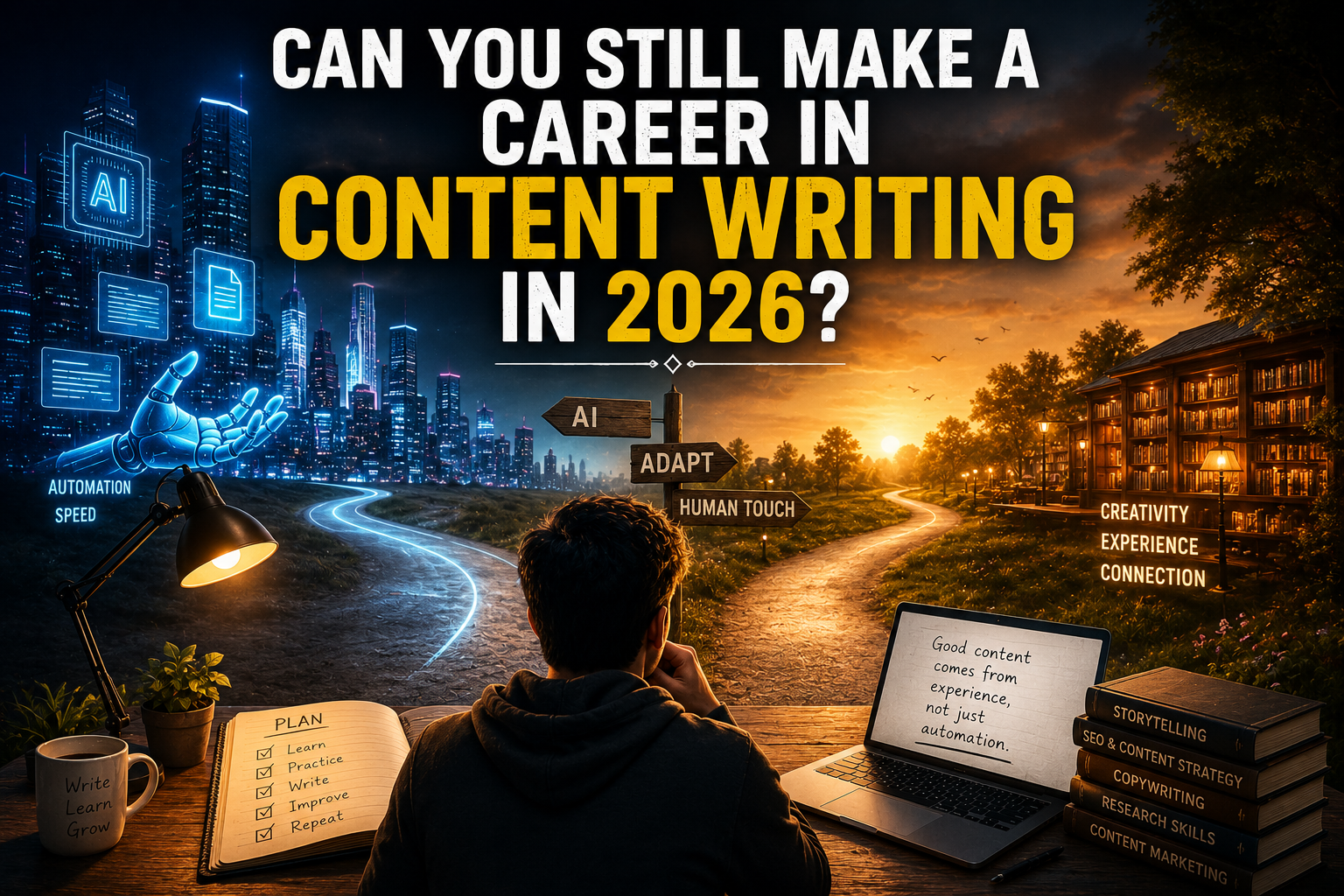
Can You Still Make a Career in Content Writing in 2026?
- August 23, 2026
- by
- Biswajit Mohanty
A question I’ve heard quite a few times lately is:
“Is content writing still worth it?”
Sometimes it comes from beginners.
Sometimes from people who have already written for a year or two.
And quite often, the reason is the same.
AI.
People see ChatGPT and other AI tools writing articles, creating captions, generating ideas, and even rewriting content within seconds.
So they naturally wonder:
Why would a company pay me to write when a machine can do it?
It’s a fair question.
I wouldn’t dismiss it.
In fact, if I were starting my writing career in 2026, I’d probably ask the same thing.
I started writing professionally around 2015. At that time, the situation was very different. There were no mainstream AI writing tools doing what they do today. Content marketplaces were active, businesses were hiring writers for regular website and SEO content, and getting started felt considerably less complicated.
Over the years, I’ve watched the industry change.
I’ve worked on SEO content, technical writing, website content, social media, content marketing, freelancing projects, and different types of business communication.
I’ve also watched AI become part of the everyday writing process.
So, do I think content writing is dead?
No.
But I also wouldn’t tell a beginner that nothing has changed.
A lot has changed.
Some types of writing have become easier to automate. Some clients now expect writers to work with AI. Some routine writing projects have become harder to find. And competition has increased significantly.
But there are still areas where businesses need people who can think, research, understand an audience, develop ideas, and communicate with some personality.
That’s where things get interesting.
The question in 2026 isn’t really:
“Can AI write?”
Of course it can.
The better question is:
“What can you bring to the table that goes beyond generating words?”
And that’s what we’ll explore here.
Why Does It Feel Like Content Writing Is Dying?
If you’ve been looking at the writing industry from the outside, it’s easy to get that impression.
Open LinkedIn or YouTube and you’ll find people talking about AI replacing writers.
Search for content writing jobs and you’ll see intense competition.
Look at freelance marketplaces and you’ll find writers offering services at surprisingly low rates.
Then open an AI tool and watch it produce a reasonably structured article in a few seconds.
It can make you question the whole profession.
I’ve had that thought myself.
Not necessarily, “Writing is finished.”
More like:
“Where is all this heading?”
That’s a different question.
Because technology has always changed writing.
SEO changed how writers approached articles.
Social media changed how brands communicated.
Short-form video changed how people consumed information.
AI is simply the biggest change we’ve seen so far.
And every major change creates winners, losers, and people who adapt somewhere in between.
Routine Writing Has Become Easier to Automate
This is probably the biggest change beginners need to understand.
If a business needs fifty basic product descriptions, AI can help create them quickly.
If someone needs ten simple social media captions, AI can generate drafts.
If a company wants a basic article explaining a common topic, AI can produce something usable in seconds.
That work used to require a writer.
Now it may require a person who can direct, review, edit, fact-check, and improve the output.
That’s a significant difference.
And writers who only offer “I can write 1,000 words for you” are facing more pressure than before.
The market has moved beyond that.
Clients increasingly want someone who can understand why the content is being created.
Is it supposed to rank on Google?
Generate leads?
Explain a complicated product?
Build authority?
Educate customers?
Sound like the brand?
Answer a specific audience question?
Those questions require thinking.
And that’s where the opportunity still exists.
So, Should You Become a Content Writer in 2026?
If you’re expecting an easy way to make money from home, I’d say no.
There are easier things to try.
Content writing requires patience.
You’ll have to write a lot.
You’ll probably produce work that you’re not proud of.
You’ll get edits.
You may lose clients.
You may send proposals and hear nothing back.
You may spend hours researching something only to realize that your first draft isn’t good enough.
That’s normal.
I went through my own version of this.
And I still make mistakes.
But if you genuinely enjoy writing, researching, learning, explaining things, and communicating ideas, then yes, I still think there’s a career here.
Just don’t enter the field thinking you’re competing against other writers alone.
You’re competing in a much broader environment now.
You’re competing against AI-generated content, low-cost writers, inexperienced freelancers, agencies, automation, and sometimes the client’s own ability to create basic content.
So your job is not simply to prove:
“I can write.”
Your job is to prove:
“I can make this content better, more useful, more accurate, more interesting, or more effective.”
That’s a much stronger position to be in.
Where Human Writers Still Have an Advantage
Here’s where I think the conversation around AI sometimes becomes too simplistic.
People compare AI and writers as if both are doing exactly the same job.
They’re not.
AI is very good at generating text.
But content writing isn’t only about generating text.
A good writer brings something else to the process.
Experience.
Judgment.
Curiosity.
Context.
And sometimes, a very specific understanding of the person sitting on the other side of the screen.
Experience Gives You Something to Say
This is one reason I believe experienced writers still have an advantage.
I’ve been writing for more than a decade.
That doesn’t mean everything I write is automatically good.
It simply means I’ve seen things.
I’ve worked with different clients.
I’ve written for different industries.
I’ve made mistakes.
I’ve received criticism.
I’ve watched projects succeed and fail.
I’ve seen how readers respond to different types of content.
All of those experiences influence how I approach a new piece of writing.
A beginner can ask AI:
“Write an article about becoming a content writer.”
And AI can produce one.
But a writer who has actually spent ten years doing the job can talk about things that aren’t obvious from a generic article.
The awkward first client call.
The client who asks for endless revisions.
The excitement of getting your first paid project.
The mistake of trying to sound too sophisticated.
The fear of criticism.
The frustration of sending proposals without getting replies.
Those details make writing feel real.
And readers notice that.
Original Stories Are Still Valuable
Think about the difference between these two sentences:
“Content writing requires patience.”
True.
But it’s generic.
Now imagine someone telling you:
“I remember staring at my inbox after sending a proposal and wondering whether anyone would ever reply.”
That’s different.
You can picture it.
You can feel the uncertainty.
That’s the power of experience.
AI can help you structure a story.
It can help you improve the language.
But the actual experience has to come from somewhere.
And personal stories are becoming increasingly valuable because the internet is already full of generic information.
There are thousands of articles explaining the same basic concepts.
What makes one worth reading?
Usually, it’s the perspective.
Research Still Matters
This might sound obvious, but good research hasn’t become less important because of AI.
If anything, I think it has become more important.
AI can give you an answer very quickly.
But quick doesn’t always mean correct.
Writers still need to verify information.
They need to understand sources.
They need to identify outdated information.
They need to recognize when something doesn’t sound right.
And if you’re writing about technical subjects, health, finance, science, law, or other areas where accuracy matters, you can’t simply accept whatever appears on your screen.
A writer needs judgment.
You need to know when to trust information and when to investigate further.
That’s a skill.
Understanding the Audience Matters More Than Ever
One of the biggest differences between mediocre content and useful content is whether the writer actually understands the reader.
Imagine you’re writing for someone who has never heard of SEO.
You can’t explain it the same way you’d explain it to an experienced digital marketer.
The information might be identical.
The writing shouldn’t be.
This is where good writers think differently.
They ask:
Who is reading this?
What do they already know?
What are they confused about?
What are they worried about?
What do they actually want to know?
What should they do after reading this?
AI can help you answer those questions.
But someone still has to ask them.
And that person needs to understand the purpose behind the content.
Brand Voice Is More Than Grammar
Another area where human writers can still add enormous value is brand voice.
Imagine two companies selling similar products.
One wants to sound friendly and conversational.
The other wants to sound authoritative and technical.
The facts might be similar.
The writing shouldn’t feel identical.
A brand has a personality.
At least, good brands do.
A writer needs to understand that personality and carry it across articles, websites, social media posts, emails, and other content.
That’s not simply a grammar exercise.
It’s interpretation.
You have to understand what the brand wants to sound like and, sometimes more importantly, what it doesn’t want to sound like.
The Writer’s Role Is Changing
This is probably the biggest shift beginners need to understand.
In the past, a client could hire you primarily because you could produce good written content.
Today, that’s often not enough.
The writer increasingly needs to become an editor, researcher, strategist, and communicator.
You might use AI to create a rough outline.
You might use it to brainstorm ideas.
You might use it to summarize information.
But then you need to take over.
Check the facts.
Question the assumptions.
Improve the structure.
Add examples.
Remove unnecessary words.
Make the tone sound human.
Bring in original insight.
And finally ask:
“Would I actually want to read this?”
That’s the difference between using AI as a shortcut and using AI as a tool.
The first approach can make your writing replaceable.
The second can make you more productive.
What Skills Should a Content Writer Learn in 2026?
If you’re starting today, don’t try to become everything at once.
I’ve seen beginners make this mistake repeatedly.
They start learning SEO.
Then copywriting.
Then social media.
Then AI.
Then web design.
Then digital marketing.
Then video editing.
After three months, they know a little about everything and still don’t feel confident about anything.
You don’t need that.
Start with the foundation.
1. Learn to Write Clearly
This sounds obvious.
It isn’t.
Good writing isn’t about complicated vocabulary.
I learned that lesson myself.
When I started professional writing, I sometimes used fancy words because I thought they made me sound more mature.
Eventually, I understood that simple writing usually works better.
Say what you mean.
Don’t stretch a sentence just to make it sound impressive.
Don’t use ten words when five will do.
And don’t make the reader work harder than necessary.
2. Learn Research
A writer who can research well will always have an advantage.
You don’t need to know everything.
You need to know how to find reliable information.
Learn how to compare sources.
Check dates.
Look for original studies or official sources when appropriate.
Understand context.
And never be afraid to say:
“I need to research this first.”
That’s not weakness.
That’s professionalism.
3. Learn Basic SEO
You don’t need to become an SEO expert immediately.
But if you want to work in digital content, you should understand the basics.
Learn about search intent.
Keywords.
Headings.
Internal linking.
Meta titles and descriptions.
Content structure.
And most importantly, understand why someone is searching for something.
SEO isn’t simply putting keywords into an article.
It’s understanding what the searcher wants.
4. Learn to Use AI
Don’t run away from AI because you’re afraid it will replace you.
Learn it.
Experiment with it.
See what it does well.
See where it fails.
Use it for brainstorming.
Use it for outlines.
Use it to explore angles.
Use it for repetitive work.
But don’t hand over your brain to it.
You should remain the person making the decisions.
5. Learn Editing
This is underrated.
Many people think writers are people who produce first drafts.
Professional writers know that writing often begins after the first draft.
Read your work again.
Remove repetition.
Shorten awkward sentences.
Check the flow.
Look for unsupported claims.
Ask whether every paragraph deserves to be there.
Sometimes the best sentence you’ll write is the one you decide to delete.
6. Learn to Understand Business
You don’t need an MBA.
But you should understand why a company wants content.
A business rarely wants an article simply because it likes having articles on its website.
It wants something from that content.
Traffic.
Leads.
Sales.
Authority.
Trust.
Customer education.
Brand awareness.
If you understand the business goal, your writing becomes much more valuable.
What Kind of Content Writing Is More Valuable Now?
This is where I think beginners should pay attention.
Not every type of writing has the same future.
Basic, repetitive content is easier to automate.
But some forms of writing require much more human involvement.
Think about:
Thought leadership
A company founder sharing an actual opinion is difficult to fake convincingly.
Case studies
Real customers have real stories.
Interviews
You need to speak to people and understand what they actually said.
Technical writing
Complex products require subject understanding and accuracy.
Original research
Someone has to conduct the research.
Personal storytelling
You can’t manufacture somebody else’s lived experience.
Brand strategy
Understanding how a business should communicate requires judgment.
Content strategy
Someone needs to decide what should be created, for whom, and why.
These areas can offer stronger opportunities than simply producing generic articles at the lowest possible rate.
You Don’t Have to Compete on Price
This is another trap beginners fall into.
They see someone offering content at ₹0.30 per word.
So they offer ₹0.20.
Then someone else offers ₹0.10.
Eventually, everyone is racing toward the bottom.
I understand why beginners do this.
When you have no clients, getting any client feels better than getting no client.
But you can’t build a sustainable career by constantly being the cheapest person available.
At some point, you need to give clients a reason to choose you beyond price.
Maybe you understand their industry.
Maybe you’re good at research.
Maybe you write technical content.
Maybe you understand SEO.
Maybe you can develop content strategies.
Maybe you can turn complicated subjects into simple explanations.
That’s where specialization can help.
You don’t have to become a niche writer immediately.
But over time, developing a recognizable strength can make a huge difference.
What About Beginners With No Experience?
This is probably the question I would worry about most if I were starting today.
“How do I get experience when nobody wants to hire me without experience?”
It’s frustrating.
But there is a way around it.
Create your own experience.
Start a blog.
Write sample articles.
Answer questions on platforms where people actually read them.
Create mock projects.
Write about subjects you’re interested in.
Build a portfolio.
You don’t need ten clients to prove you can write.
Sometimes five genuinely good samples are more useful than fifty mediocre ones.
And don’t wait until your writing is “perfect.”
It won’t be.
Mine wasn’t.
It still isn’t.
You improve by publishing, receiving feedback, studying good writing, and doing the work repeatedly.
So, Can You Actually Make Money From Content Writing in 2026?
Yes.
But I wouldn’t sell you a dream.
It may take time.
Your first few projects may not pay much.
Finding good clients can be difficult.
You may have to work through some low-paying opportunities before you build enough experience to move up.
And there will be periods when work is slow.
That’s part of freelancing.
But there are still businesses that need writers.
There are websites that need content.
There are software companies that need technical writers.
There are founders who need thought leadership.
There are agencies that need reliable writers.
There are brands that need people who understand their voice.
There are publications looking for contributors.
The opportunities haven’t disappeared.
They’ve shifted.
And I think that’s the part beginners need to understand.
You aren’t entering the same content-writing industry I entered in 2015.
You shouldn’t try to.
If I Were Starting Content Writing Today
If I were starting from zero in 2026, I’d do things differently.
I wouldn’t spend six months trying to learn every digital marketing skill.
I’d start writing immediately.
I’d read every day.
I’d create a simple portfolio.
I’d learn basic SEO.
I’d learn how AI works and use it as a tool.
I’d publish my own work.
I’d study what good writers are doing.
I’d contact potential clients.
I’d accept that my first few projects might not be perfect.
And I’d focus heavily on improving.
Most importantly, I wouldn’t expect the first month to change my life.
I’d give myself time.
That’s something the internet doesn’t teach very well.
Everything online looks fast.
Fast money.
Fast growth.
Fast followers.
Fast success.
Real careers rarely work that way.
The Future Belongs to Adaptable Writers
I don’t think the future belongs to writers who completely reject AI.
But I also don’t think it belongs to writers who blindly depend on it.
The future probably belongs somewhere in the middle.
Writers who know how to think.
Writers who know how to research.
Writers who understand people.
Writers who can use AI without becoming dependent on it.
Writers who can edit.
Writers who can develop ideas.
Writers who can bring experience and personality into their work.
That’s the kind of writer I’d want to be.
And that’s the kind of writer I’d encourage a beginner to become.
Final Thoughts
So, can you still make a career in content writing in 2026?
Yes.
But the old version of content writing is changing.
If your entire skill is producing 1,000 words on a generic topic, you’re going to face more competition than ever.
AI can already do much of that work.
But if you can research deeply, understand an audience, develop original ideas, write with personality, understand business goals, and use AI intelligently, you’re playing a different game.
And that’s the important distinction.
Don’t try to become a writer who competes with AI at producing words faster.
Become a writer who knows what should be written, why it should be written, who should read it, and how it should make them feel or act.
That’s much harder to replace.
I’ve been writing since long before AI became part of the conversation.
I’ve watched the industry change more than once.
And I’m sure it will change again.
Maybe the tools we’ll be using five years from now will look completely different from what we use today.
That’s okay.
I’ve learned not to build my career around a particular tool.
I build it around the ability to learn, adapt, and communicate.
Tools come and go.
Writing evolves.
But people will always have something to say, something to ask, something to learn, and something to sell.
And as long as people need to communicate, there will be room for good writers.
The opportunity is still there.
It’s just not the same opportunity it was in 2015.
And honestly, that’s not necessarily a bad thing.
It simply means we have to become better writers than we were yesterday.
You may also Like


How Much Should a Beginner Content Writer Charge?