


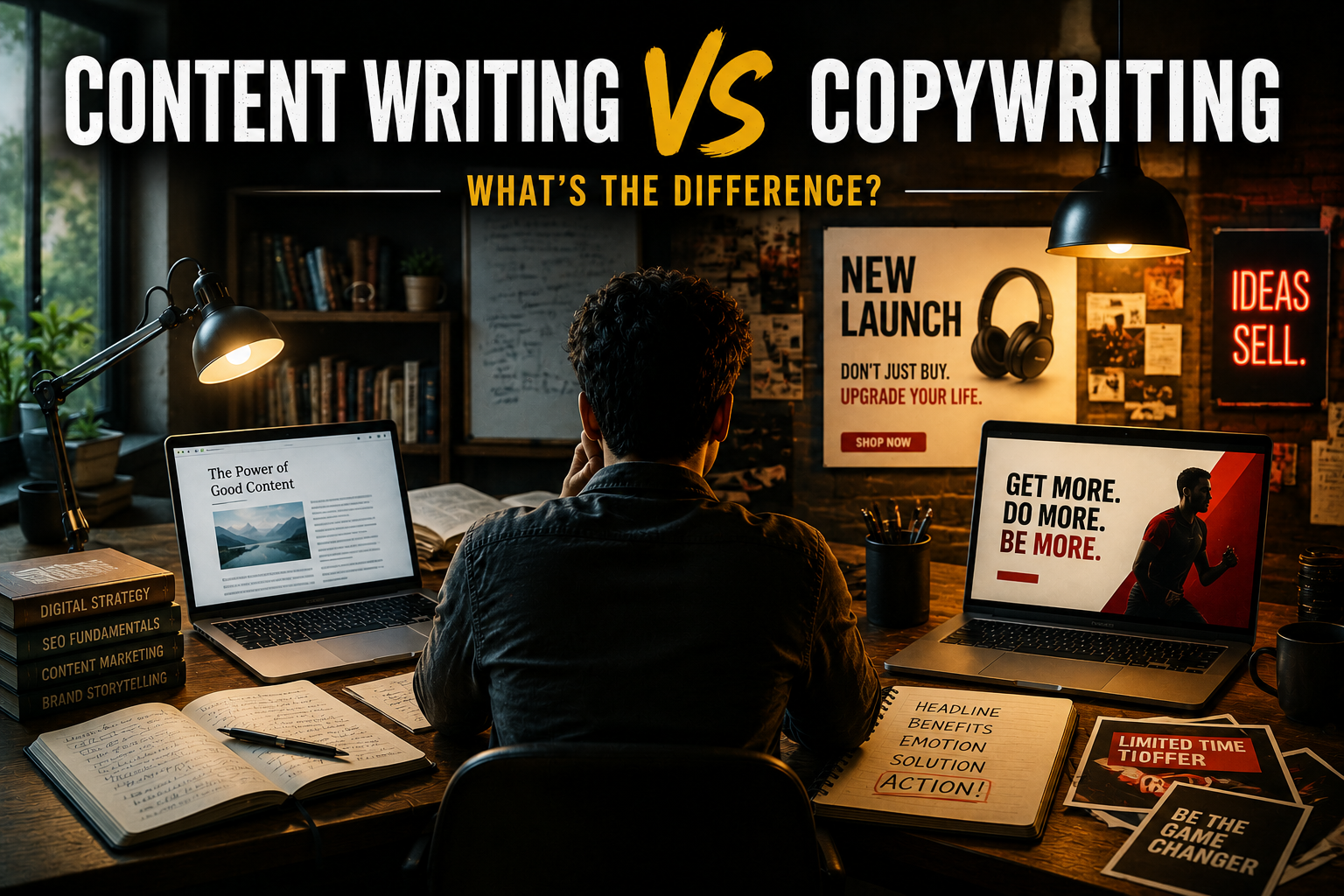
Content Writing vs Copywriting: What’s the Difference?
- August 23, 2026
- by
- Biswajit Mohanty
A few years ago, I wouldn’t have been surprised if someone asked me this question:
“Aren’t content writing and copywriting basically the same thing?”
Honestly, I can understand why people think that.
Both involve writing.
Both can involve websites.
Both can involve businesses.
Both can involve SEO, marketing, and digital platforms.
And both can pay you for putting words together.
But the purpose behind those words can be very different.
I’ve worked on both sides of this world in different ways over the years. I’ve written articles, website content, technical content, social media content, marketing material, and other forms of business communication.
And one thing I’ve noticed is that beginners often use the terms interchangeably.
That’s not necessarily a problem when you’re just starting.
But if you want to build a career, understanding the difference can help you choose the right skill to develop.
So let’s make this simple.
Content Writing Is Usually About Informing
Think about the last time you searched Google because you wanted to understand something.
Maybe you wanted to know how cloud computing works.
Perhaps you searched for the best running shoes for beginners.
Or maybe you wanted to learn how to start freelancing.
You weren’t necessarily ready to buy something.
You wanted information first.
That’s where content writing comes in.
A content writer creates material that informs, educates, answers questions, explains ideas, or keeps an audience engaged.
That can include:
- Blog articles
- Website articles
- Guides
- Tutorials
- Educational content
- Case studies
- Ebooks
- Technical documentation
- Social media content
- Newsletters
- Long-form articles
The goal isn’t always to make an immediate sale.
Sometimes the goal is simply to help someone.
And that help can eventually build trust.
Imagine a software company publishes an article explaining:
“What Is Cloud PBX and How Does It Work?”
Someone searches for the answer.
They find the company’s article.
They read it.
They understand the subject.
Maybe they read another article.
Then another.
Eventually, they start seeing that company as knowledgeable.
Perhaps months later, they need a Cloud PBX solution.
Guess who they might remember?
That’s one of the long-term benefits of content.
Good content can introduce a business to people before those people are ready to buy.
Copywriting Has a More Direct Purpose
Copywriting is different.
Here, the words are usually designed to persuade someone to take an action.
That action could be:
- Buy a product
- Sign up for a service
- Book a consultation
- Download something
- Subscribe to an email list
- Click an advertisement
- Request a quote
- Register for an event
Think about an advertisement you see on Instagram.
You don’t usually get several paragraphs explaining the entire history of the product.
You get a message designed to make you stop scrolling.
Maybe it highlights a problem.
Then it presents a solution.
Then it gives you a reason to act.
That’s copywriting.
A landing page is another good example.
Suppose a company sells an email marketing platform.
A content writer might write an article titled:
“How Email Marketing Can Help Small Businesses Build Customer Relationships.”
A copywriter might write the landing page that says:
“Turn More Subscribers Into Customers.”
The first educates.
The second persuades.
That’s the easiest way to remember the difference.
Content Builds Interest. Copy Drives Action.
Of course, the line isn’t always perfectly clear.
Content can persuade.
Copy can educate.
But their primary intentions are often different.
A simple way to think about it is:
Content says:
“Let me help you understand this.”
Copy says:
“Here’s why you should take action.”
Neither is better.
They’re simply doing different jobs.
And good marketing often needs both.
Let’s Take a Real Example
Imagine a company selling fitness equipment.
It wants to attract people through Google.
A content writer might create:
“How to Start Strength Training at Home.”
The article could explain equipment, exercises, safety, beginner mistakes, and training routines.
The reader gets useful information.
Now imagine that same company launches a new adjustable dumbbell.
The copywriter might write:
“One Set. Dozens of Workouts. No Bulky Gym Equipment.”
Then perhaps:
“Build your home gym without filling your room with equipment.”
And finally:
“Shop Now.”
Notice the difference?
The content writer is helping the reader learn.
The copywriter is trying to move the reader toward a decision.
Both pieces can be extremely valuable to the same business.
Content Writing Often Plays the Long Game
This is something beginners sometimes overlook.
Content doesn’t always produce an immediate result.
You might spend several hours researching and writing an excellent article.
It gets published.
And…
Nothing happens.
No flood of visitors.
No sudden sales.
No dramatic response.
That’s normal.
The article might take weeks or months to gain search visibility.
It might bring a small number of visitors at first.
Those visitors may read it and leave.
But another person might find it six months later.
That person might read three more pages.
They might subscribe to the company’s newsletter.
And eventually, they might become a customer.
Content can work quietly in the background.
That’s why businesses often use it as part of a long-term marketing strategy.
Copywriting Often Wants the Reader to Act Now
Copywriting tends to be more immediate.
A good advertisement has a very small window to capture attention.
You’re scrolling.
You see something.
You have perhaps a second or two before you move on.
The copy needs to make you stop.
That’s why copywriters spend a lot of time thinking about things like:
What does the customer want?
What problem are they experiencing?
What would make them care?
What objection might stop them from buying?
What should they do next?
Copywriting is closely connected to psychology.
Not in some mysterious way.
It’s simply about understanding what motivates people.
A good copywriter knows that people don’t always buy because of features.
They buy because of what those features mean to them.
A phone with a powerful camera isn’t just selling megapixels.
It might be selling the ability to capture family moments.
A productivity app isn’t simply selling software.
It might be selling the feeling of finally getting control over a chaotic workday.
That’s where copy becomes interesting.
Content Writing Needs Strong Research
One of the things I’ve enjoyed most about content writing is research.
I’ve written about subjects I knew almost nothing about when I started.
Technology.
Healthcare.
Education.
Finance.
Science.
VoIP.
Digital marketing.
And plenty of other areas.
You don’t have to be an expert in every subject before writing about it.
But you do need to learn.
That’s why research is such an important writing skill.
You need to understand the subject before explaining it to someone else.
You need to find reliable information.
You need to organize it.
And then you need to explain it in a way the reader can actually understand.
That’s especially important when writing technical or educational content.
Copywriting Needs Strong Audience Understanding
Copywriting also requires research, but the questions can be different.
Instead of only asking:
“What information does the reader need?”
you might ask:
“What does this person want?”
Maybe they’re tired of wasting money on a product that doesn’t work.
Maybe they’re frustrated with their current software.
Maybe they’re worried about making the wrong decision.
Maybe they want to save time.
Maybe they want to look better.
Maybe they want to make more money.
Understanding that emotional and practical context can dramatically change the copy.
That’s why a copywriter often studies the customer before writing a single headline.
SEO Is Common in Content Writing
If you’re interested in content writing, you’ll probably encounter SEO very quickly.
Search engine optimization has been closely connected with online content for years.
A content writer may need to understand:
- Search intent
- Keywords
- Headings
- Internal links
- Content structure
- Meta descriptions
- Topic relevance
- User experience
But here’s something I learned fairly early in my career.
SEO writing isn’t about stuffing keywords into every paragraph.
That’s not writing.
That’s filling space.
The real goal is to create something useful for the person who searched for the topic.
Search engines have become much better at understanding content.
So writers need to think beyond keywords.
Copywriting Also Appears in SEO
This is where things start overlapping.
A landing page can target search terms.
A product page can rank on Google.
A blog can contain persuasive elements.
A sales page can educate the reader before asking for an action.
So don’t treat content writing and copywriting as two completely separate worlds.
They overlap quite a lot.
The difference is mainly in the primary purpose.
Which One Is Easier for a Beginner?
I’d be careful with this question.
Neither is automatically easy.
But they require different kinds of thinking.
Content writing can be a comfortable starting point if you enjoy researching subjects and explaining things.
You can begin by writing blog posts, guides, tutorials, and informational articles.
Copywriting can feel more demanding if you’re new because you’re expected to understand persuasion, customer psychology, offers, objections, and calls to action.
And the pressure can be different.
If a blog article isn’t perfect, the reader might simply stop reading.
If a sales page isn’t convincing, the business may lose a potential customer.
That’s a bigger responsibility.
But it also means strong copywriting skills can be highly valuable.
Can a Content Writer Become a Copywriter?
Absolutely.
In fact, I think content writing can give you a strong foundation.
If you’ve spent years researching topics and explaining complicated ideas, you’ve already developed some useful skills.
You know how to structure information.
You know how to communicate.
You understand readers.
You know how to write clearly.
Now you need to learn persuasion.
You’ll have to study headlines.
Calls to action.
Offers.
Customer objections.
Benefits versus features.
Landing pages.
Advertising.
And, most importantly, why people make decisions.
The transition isn’t automatic.
But it is completely possible.
The reverse can also happen.
A good copywriter can learn content writing.
The two disciplines can strengthen each other.
What Should You Learn First?
If you’re completely new to professional writing, I’d personally start with content writing.
Not because it’s better.
Because it gives you room to develop the fundamentals.
Learn to research.
Learn to structure an article.
Learn to write clearly.
Learn how to edit.
Learn basic SEO.
Learn how to understand an audience.
Then start exploring copywriting.
Try writing headlines.
Rewrite advertisements.
Study landing pages.
Write product descriptions.
Experiment with calls to action.
You’ll start noticing something interesting.
The same sentence can be written in several ways depending on what you want the reader to do.
That’s when writing starts becoming more than simply putting words together.
You Don’t Have to Choose Only One Forever
This is probably the biggest thing I’d tell beginners.
Don’t worry too much about choosing the perfect label.
You don’t have to announce:
“I am a content writer and I will never write copy.”
Careers don’t work that neatly.
Your skills will evolve.
When I started writing professionally, I was mainly focused on getting projects and doing good work.
Over time, I moved through different forms of writing.
SEO content.
Technical writing.
Website content.
Social media.
Marketing content.
Research-based articles.
And other forms of communication.
That’s normal.
Your first writing skill doesn’t have to become your final career identity.
Learn.
Experiment.
Notice what you’re good at.
Notice what you enjoy.
Then build from there.
So, Which One Should You Choose?
If you enjoy researching, explaining, teaching, and exploring topics, content writing may suit you.
If you enjoy persuasion, psychology, advertising, sales, and creating strong messages, copywriting may be a better fit.
If you enjoy both?
Even better.
Because businesses often need people who can do both.
A writer who can produce a useful article and then write the landing page promoting the company’s service has a valuable combination of skills.
And that’s something worth thinking about.
Don’t limit yourself to a job title.
Build skills.
Job titles change.
Skills stay with you.
Final Thoughts
Content writing and copywriting may look similar from the outside.
Both involve words.
Both require strong communication.
Both can become careers.
But they’re solving different problems.
Content writing helps people understand.
Copywriting helps people decide.
That’s not an absolute rule, of course.
There will always be overlap.
But if you’re just starting, this distinction gives you a useful foundation.
And don’t worry if you still feel confused.
I did too, in different ways, when I started.
You learn by doing.
Write an article.
Then try writing an advertisement.
Write a product description.
Try a landing page.
Study what happens.
You’ll gradually understand what feels natural to you.
The best writers I’ve come across aren’t always the ones who stayed inside one narrow category.
They’re the ones who kept learning how communication works.
And that’s probably the better goal for any beginner.
Don’t just try to become someone who can write.
Become someone who understands why the words need to be written in the first place.
You may also Like

Can You Still Make a Career in Content Writing in 2026?